

FORMAT: DOWNLOAD
This product is not supplied in physical format. You will receive an email from our store with the download link and product activation code.
 Security policy
(edit with the Customer Reassurance module)
 Delivery policy
(edit with the Customer Reassurance module)
 Return policy
(edit with the Customer Reassurance module)
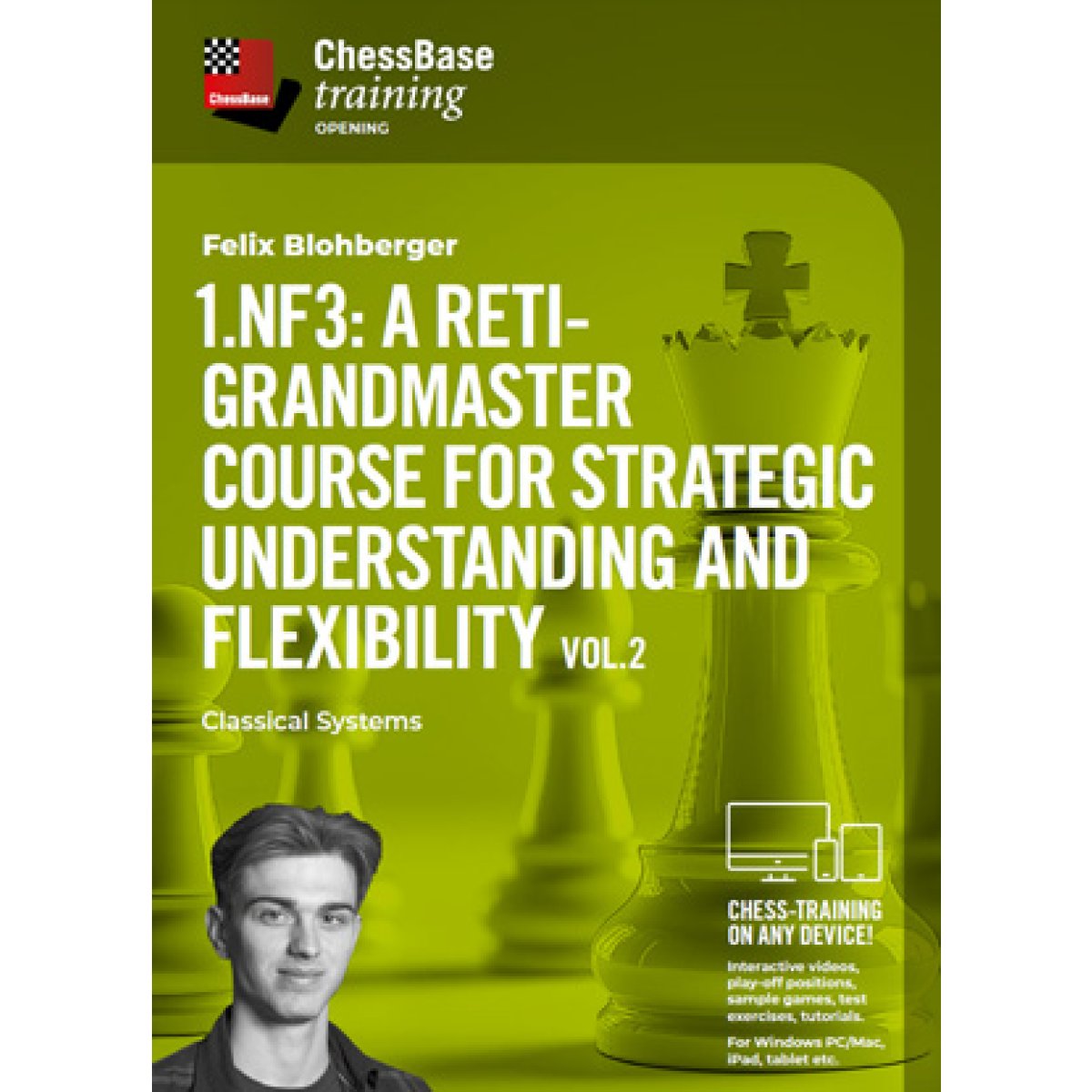
Are you looking for a versatile and strategic opening repertoire that doesn't rely on memorizing endless variations? In this course, Grandmaster Felix Blohberger offers a complete repertoire for White, centered on the flexible move 1.Nf3. Whether you are a club player or an experienced competitor, this course proposes a solid and dynamic approach that adapts to different styles and opponents.
Sample video: Introduction
Sample video: 2...Bg4 3.Bg2 c6/Nd7
Instead of forced lines, Felix emphasizes deep positional understanding and flexible structures, facilitating transitions into systems such as the Reti or the English Opening. His recommended kingside fianchetto offers a strong and reliable setup, ideal for those who prefer strategic and adaptable play rather than memorizing long complicated sequences.
This volume covers classical systems with central pawns: 1... c5, 1... d5, the Classical Variation (d5, Nf6, e6, Be7, short castle), the Tarrasch Defense, and the Triangle System.
Extensive training content and interactive exercises in ChessBase Books:
Repeat key positions, solve exercises to find decisive moves, and test your knowledge with the opening trainer.
In the 1920s, the so-called "hypermodernists" broke with the dogma that the center must be occupied by pawns at the start of the game. Instead of playing 1.e4 or 1.d4, they opened with 1.Nf3 and allowed Black to respond classically with 1...d5. This leads to the starting position of Richard Reti's system (1889–1929), who since 1923 used this opening with great success against top opponents. In the Reti system, White temporarily holds back the central pawns, increasing central influence through the kingside fianchetto with g3, Bg2, and planning to attack Black’s d-pawn with c2-c4, either on the second move or later.
FORMAT: DOWNLOAD
This product is not supplied in physical format. You will receive an email from our store with the download link and product activation code.