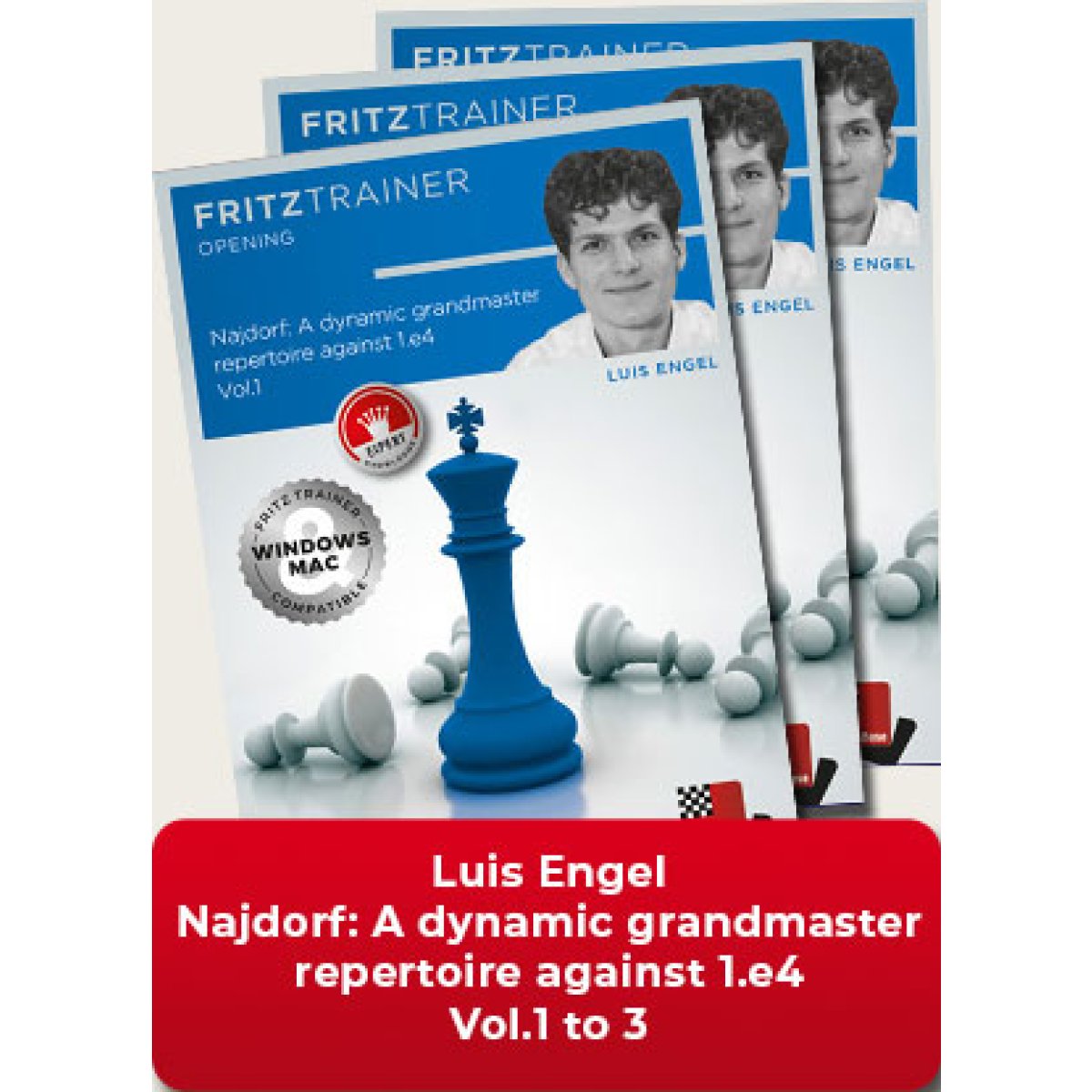


A dynamic grandmaster repertoire against 1.e4 Vol.1 to 3
search
  • A dynamic grandmaster repertoire against 1.e4 Vol.1 to 3

A dynamic grandmaster repertoire against 1.e4 Vol.1 to 3

€99.90
Tax included
Master the Najdorf Defense with this comprehensive three-volume repertoire designed to face all of White’s responses after 1.e4 c5 2.Nf3 d6 3.d4 cxd4 4.Nxd4 Nf6 5.Nc3 a6. Combine deep strategy and aggressive play with interactive lessons, tactical exercises, and practical training. Ideal for players seeking a solid and dynamic mastery against 1.e4, including Anti-Sicilian variations as well.

FORMAT: DOWNLOAD
This product is not supplied in physical format. You will receive an email from our store with the download link and product activation code.

Quantity
In Stock

  Security policy

(edit with the Customer Reassurance module)

  Delivery policy

(edit with the Customer Reassurance module)

  Return policy

(edit with the Customer Reassurance module)

This three-part Fritztrainer series offers you a complete repertoire to face all the responses White has tried against the Najdorf on the sixth move, following the initial moves 1.e4 c5 2.Nf3 d6 3.d4 cxd4 4.Nxd4 Nf6 5.Nc3 a6.

Najdorf: Dynamic Grandmaster Repertoire against 1.e4 Vol.1

This two-part Fritztrainer presents a comprehensive repertoire for all the options White has employed on the sixth move against the Najdorf, after the opening 1.e4 c5 2.Nf3 d6 3.d4 cxd4 4.Nxd4 Nf6 5.Nc3 a6.

The Najdorf Variation combines aggressive chess with deep strategic plans, offering something for every type of player. Clear ways for White to gain an advantage in the opening have not yet been found, making this variation one of the best and most frequently played.

In the first part of the video course, we analyze White’s four main moves: 6.Bg5, 6.Be3, 6.Be2, and 6.Bc4. Additionally, this Fritztrainer includes more than 20 positions to practice and reinforce the key positions of the repertoire. With the Opening App, you can test your memory of the theory presented.

  • Video duration: 5 hours 9 minutes
  • Training with ChessBase applications to memorize the repertoire and play key positions against Fritz at different levels

Najdorf: Dynamic Grandmaster Repertoire against 1.e4 Vol.2

This second part of the Fritztrainer completes the repertoire for all the other moves White has tried on the sixth move against the Najdorf, following the initial moves 1.e4 c5 2.Nf3 d6 3.d4 cxd4 4.Nxd4 Nf6 5.Nc3 a6.

The Najdorf Variation continues to combine aggressive chess with deep strategic plans, being one of the most played and respected openings.

In this second part, all other moves that White has tried on the sixth move are studied, mainly: 6.h3, as well as other options such as 6.g3, 6.Rg1, and more. It also includes more than 20 positions to play and tactical exercises that consolidate the most important positions and motifs of the repertoire. The Opening App will allow you to evaluate your knowledge of the theory shown in this video course.

  • Video duration: 3 hours 44 minutes
  • Interactive training with video feedback
  • Training with ChessBase applications to memorize the repertoire

Discovering the Anti-Sicilians: Dynamic Grandmaster Repertoire against 1.e4 Vol.3

Who hasn’t experienced this? You are ready for an exciting game in the Open Sicilian Najdorf, and suddenly your opponent plays one of the countless minor variations to avoid the main lines. Frustration? Not at all. This Fritztrainer is the perfect complement to any Sicilian or Najdorf repertoire, covering all the minor variations White uses to sidestep the Open Sicilian. If you already have the two Fritztrainers covering the Sicilian Najdorf after 5... a6, you will have a complete and comprehensive grandmaster repertoire against 1.e4.

We start exploring the Anti-Sicilians with important and popular alternative second moves, highlighting the Grand Prix Attack (2.Nc3) and the Alapin Variation (2.c3), as well as other minor second-move variations White has tried. Even if you don’t play Najdorf when choosing the Sicilian, this course is suitable for your repertoire. After the main move 2.Nf3 d6, we continue with alternatives to the third move 3.d4, particularly the popular 3.Bb5+. Also covered are the line 3.d4 cxd4 4.Qxd4!? and the move 5.f3, popular as a surprise weapon, as well as other rare lines until reaching the starting position of the Najdorf after 5... a6.

  • Video duration: 4 hours 45 minutes
  • Training with ChessBase applications to memorize the repertoire and play key positions against Fritz at various levels
More... Less...

The package includes:

Delivered content:
  • Fritztrainer application for Windows and Mac
  • Available for download or on DVD
  • Video course with approximate duration of 4 to 8 hours
  • Repertoire database: save and integrate Fritztrainer games into your own repertoire (in WebApp Opening or ChessBase)
  • Interactive exercises with video feedback: authors present exercises and key positions; the user must enter the solution, receiving comments and explanations, even in case of mistakes
  • Example games as a ChessBase database
  • New: many Fritztrainers also available for streaming on the ChessBase video portal
Features of the FritzTrainer application:
  • Videos can be played in the Fritztrainer application or in the ChessBase program with board graphics, notation, and an extensive function bar
  • The analysis engine can be activated at any time
  • Pause for manual navigation and analysis in the game notation
  • Input of own variations, engine analysis, and storage in the game
  • Variation learning: view specific lines in ChessBase WebApp Opening with automatic playback, memorize variations, and practice the transition from initial to final position
  • Active opening training: selected positions are transferred to ChessBase WebApp Fritz-online to play against Fritz and test acquired knowledge
More features: Launch FritzTrainer in the ChessBase program
  • The database with all games and analysis can be opened directly
  • Games can easily be added as opening references
  • Direct evaluation with game referencing; games can be played through on the analysis board
  • Own variations are saved and can be incorporated into the personal repertoire
  • Reproduction training
  • Active LiveBook
  • All engines installed in ChessBase can be used for analysis
  • Assisted analysis
  • Printing of notation and diagrams (for study sheets)

Sample video

Contents

    Najdorf: Dynamic Grandmaster Repertoire against 1.e4 Vol.1

  • Introduction
  • 6.Bg5
  • 1.e4 c5 2.Nf3 d6 3.d4 cxd4 4.Nxd4 Nf6 5.Nc3 a6
  • 6.Bg5 e6 - Secondary variations
  • 6.Bg5 e6 7.f4 h6 8.Bh4 Nbd7 9.Qf3 and Bc4
  • 6.Bg5 e6 7.f4 h6 8.Bh4 Nbd7 9.Qe2
  • 6.Be3
  • 1.e4 c5 2.Nf3 d6 3.d4 cxd4 4.Nxd4 Nf6 5.Nc3 a6
  • 6.Be3 e5 7.Nf3
  • 6.Be3 e5 7.Nb3 Be6 8.h3 and Qd2
  • 6.Be3 e5 7.Nb3 Be6 8.f3 h5 9.Nd5
  • 6.Be3 e5 7.Nb3 Be6 8.f3 h5 9.Qd2
  • 6.Be2
  • 1.e4 c5 2.Nf3 d6 3.d4 cxd4 4.Nxd4 Nf6 5.Nc3 a6
  • 6.Be2 e5 7.Nf3 Be7 8.Bg5 and 7.Nb3 Be7 8.Bg5
  • 6.Be2 e5 7.Nb3 Be7 8th move alternatives
  • 6.Be2 e5 7.Nb3 Be7 8.0-0 0-0 9th move alternatives
  • 6.Be2 e5 7.Nb3 Be7 8.0-0 0-0 9.Be3
  • 6.Bc4
  • 1.e4 c5 2.Nf3 d6 3.d4 cxd4 4.Nxd4 Nf6 5.Nc3 a6
  • 6.Bc4 e6 7th move alternatives
  • 6.Bc4 e6 7.Bb3
  • Repertoire training
  • 6.Bg5
  • 6.Be3
  • 6.Be2
  • 6.Bc4
  • Practice positions
  • 6.Bg5 Secondary variations 1
  • 6.Bg5 Secondary variations 2
  • 6.Bg5 9.Qf3 and 9.Bc4 1
  • 6.Bg5 9.Qf3 and 9.Bc4 2
  • 6.Bg5 9.Qe2 1
  • 6.Bg5 9.Qe2 2
  • 6.Be3 7.Nf3 1
  • 6.Be3 7.Nf3 2
  • 6.Be3 8.h3 and 8.Qd2 1
  • 6.Be3 8.h3 and 8.Qd2 2
  • 6.Be3 9.Nd5 1
  • 6.Be3 9.Nd5 2
  • 6.Be3 9.Qd2 1
  • 6.Be3 9.Qd2 2
  • 6.Be2 7.Nf3 and 7.Nb3, 8.Bg5 1
  • 6.Be2 7.Nf3 and 7.Nb3, 8.Bg5 2
  • 6.Be2 8th move alternatives 1
  • 6.Be2 8th move alternatives 2
  • 6.Be2 9th move alternatives 1
  • 6.Be2 8th move alternatives 2
  • 6.Be2 9.Be3 1
  • 6.Be2 9.Be3 2
  • 6.Bc4 7th move alternatives 1
  • 6.Bc4 7th move alternatives 2
  • 6.Bc4 7.Bb3 1
  • 6.Bc4 7.Bb3 2
  • Bonus
  • Analysis

    Najdorf: Dynamic Grandmaster Repertoire against 1.e4 Vol.2

  • Introduction
  • 6.h3
  • 1.e4 c5 2.Nf3 d6 3.d4 cxd4 4.Nxd4 Nf6 5.Nc3 a6
  • 6.h3 e6 7.g4
  • 6.g3
  • 1.e4 c5 2.Nf3 d6 3.d4 cxd4 4.Nxd4 Nf6 5.Nc3 a6
  • 6.g3 e5 7.Nde2/Nb3
  • 6.f4
  • 1.e4 c5 2.Nf3 d6 3.d4 cxd4 4.Nxd4 Nf6 5.Nc3 a6
  • 6.f4 e5 7.Nf3
  • 6.a4
  • 1.e4 c5 2.Nf3 d6 3.d4 cxd4 4.Nxd4 Nf6 5.Nc3 a6
  • 6.a4 e5 7.Nf3
  • 6.Bd3
  • 1.e4 c5 2.Nf3 d6 3.d4 cxd4 4.Nxd4 Nf6 5.Nc3 a6
  • 6.Bd3 g6 7.f3/0-0
  • 6.Rg1
  • 1.e4 c5 2.Nf3 d6 3.d4 cxd4 4.Nxd4 Nf6 5.Nc3 a6
  • 6.Rg1 e5 7.Nb3
  • 6.Nb3
  • 1.e4 c5 2.Nf3 d6 3.d4 cxd4 4.Nxd4 Nf6 5.Nc3 a6
  • 6.Nb3 e6 7.g4
  • 6.h4/a3/Bd2
  • 1.e4 c5 2.Nf3 d6 3.d4 cxd4 4.Nxd4 Nf6 5.Nc3 a6
  • 6.h4/a3/Bd2
  • 6.Qf3/Qd3/Qe2
  • 1.e4 c5 2.Nf3 d6 3.d4 cxd4 4.Nxd4 Nf6 5.Nc3 a6
  • 6.Qf3/Qd3/Qe2
  • Exercises
  • Exercise 1
  • Exercise 2
  • Exercise 3
  • Exercise 4
  • Exercise 5
  • Exercise 6
  • Exercise 7
  • Exercise 8
  • Exercise 9
  • Exercise 10
  • Exercise 11
  • Exercise 12
  • Exercise 13
  • Exercise 14
  • Exercise 15
  • Exercise 16
  • Repertoire training
  • 6.h3
  • 6.g3
  • 6.f4
  • 6.a4
  • 6.Bd3
  • 6.Rg1
  • 6.Nb3
  • 6.h4, 6.a3, 6.Bd2
  • 6.Qf3, 6.Qd3, 6.Qe2
  • Practice positions
  • 6.h3 1
  • 6.h3 2
  • 6.g3 1
  • 6.g3 2
  • 6.f4 1
  • 6.f4 2
  • 6.a4 1
  • 6.a4 2
  • 6.Bd3 1
  • 6.Bd3 2
  • 6.Rg1 1
  • 6.Rg1 2
  • 6.Nb3 1
  • 6.Nb3 2
  • Minor sixth-move variations 1
  • Minor sixth-move variations 2
  • Minor sixth-move variations 3
  • Minor sixth-move variations 4
  • Bonus
  • Analysis

    Discovering the Anti-Sicilians: Dynamic Grandmaster Repertoire against 1.e4 Vol.3

  • Introduction
  • Alapin: 1.e4 c5 2.c3
  • 1.e4 c5 2.c3 Nf6
  • Secondary variations
  • Main line: 3.e5 Nd5 4.d4 cxd4 5.Nf3 d6
  • Grand Prix Attack: 1.e4 c5 2.Nc3
  • 1.e4 c5 2.Nc3 d6
  • Secondary variations: 3.g3/d4/Alternatives
  • 3.f4
  • Secondary variations on second move
  • Secondary variations on second move
  • 2.f4/Bc4/c4
  • 2.Ne2/g3/Be2/Na3
  • 2.b4/b3/a3
  • Secondary variations on third move
  • Secondary variations on third move
  • 3.Nc3 and secondary variations
  • 3.c3
  • Moscow Variation: 1.e4 c5 2.Nf3 d6 3.Bb5+
  • 1.e4 c5 2.Nf3 d6 3.Bb5+ Bd7
  • Secondary variations
  • Main line: 4.Bxd7 Qxd7 5.c4 Nc6
  • Secondary variations on fourth and fifth moves
  • Secondary variations on fourth and fifth moves
  • 3.d4 cxd4 4.Qxd4
  • 3.d4 cxd4 4.Nxd4 Nf6 5.f3
  • Repertoire training
  • Description
  • Secondary variations of 2.c3 Alapin
  • Main line 2.c3 Alapin
  • Grand Prix Attack 3.g3/d4/Secondary variations
  • Grand Prix Attack 3.f4
  • Secondary variations on second move - 2.f4/Bc4/c4
  • Secondary variations on second move - 2.Ne2/g3/Be2/Na3
  • Secondary variations on second move - 2.b3/b4/a3
  • Secondary variations on third move - 3.Nc3/Secondary variations
  • Secondary variations on third move - 3.c3
  • Secondary variations on third move - 3.Bb5 Secondary variations
  • Secondary variations on third move - 3.Bb5 Main line
  • 4.Qxd4
  • 5.f3
  • Practice positions
  • Description
  • Alapin position 1
  • Alapin position 2
  • Alapin position 3
  • Alapin position 4
  • Grand Prix Attack position 1
  • Grand Prix Attack position 2
  • Grand Prix Attack position 3
  • Grand Prix Attack position 4
  • Secondary variations on second move position 1
  • Secondary variations on second move position 2
  • Secondary variations on second move position 3
  • Secondary variations on second move position 4
  • Secondary variations on second move position 5
  • Secondary variations on second move position 6
  • Secondary variations on third move position 1
  • Secondary variations on third move position 2
  • Secondary variations on third move position 3
  • Secondary variations on third move position 4
  • Secondary variations on third move position 5
  • Secondary variations on third move position 6
  • Secondary variations on third move position 7
  • Secondary variations on third move position 8
  • 4.Qxd4 Position 1
  • 4.Qxd4 Position 2
  • Secondary variations on fifth move position 1
  • Secondary variations on fifth move position 2
More...
Less...

Sicilian Defense

The moves 1.e4 c5 define the Sicilian Defense. Black fights for the d4 square, but unlike the symmetrical double e-pawn advance, symmetry is immediately broken, indicating Black is not just aiming to equalize. From here, the game can proceed along various lines. 2.Nf3 followed by 3.d4 cxd4 4.Nxd4 leads to the Open Sicilian. Before that, Black can determine the opening’s direction with 2...d6, 2...e6, or 2...Nc6. Currently, systems where White avoids an early d4 are also popular.

ADGRA1VT3-GXLC