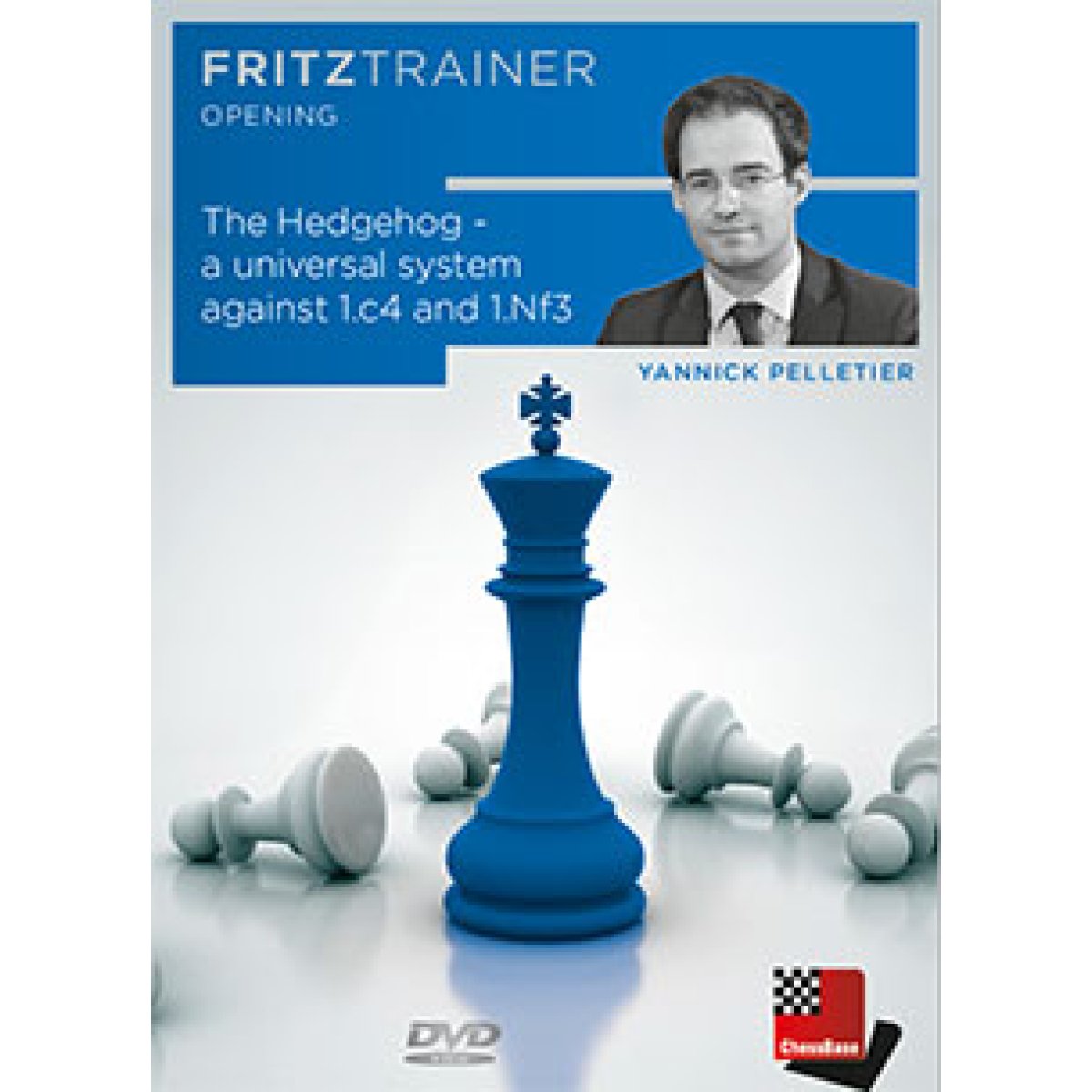
The Hedgehog - a universal system against 1.c4 and 1.Nf3
€29.90
Tax included
Discover "The Hedgehog," a clever and flexible opening system to respond to 1.c4 and 1.Nf3. With a solid approach and tactical counterattacks, this course of over 5 hours, taught by Grandmaster Yannick Pelletier, offers detailed analyses, interactive exercises with video feedback, and an extensive database of annotated games to master this defense used by world champions. Ideal for all styles and levels.
FORMAT: DOWNLOAD This product is not provided in physical format. You will receive an email from our store with the download link and product activation code.
The Hedgehog system is a clever opening characterized by a very particular pawn structure. At first glance, Black’s setup may seem somewhat passive, but appearances are deceiving! In this opening, Black always waits for the right moment to seize the initiative and launch a counterattack, placing their pieces in perfect harmony behind a pawn wall and patiently waiting for the exact moment to open the position and unleash their full potential. Great world champions like Kasparov, Karpov, and Carlsen have employed the Hedgehog. It is a versatile system, suitable for any playing style and can arise from multiple openings.
In this DVD, the great Swiss grandmaster Yannick Pelletier offers you a complete Hedgehog repertoire against the English and Reti openings. He explains several theoretical variations supported by exemplary games. As always, the details make the difference and practice is essential: the interactive section with personalized questions from the author is ideal for that. Yannick Pelletier provides feedback on your moves, offers hints, and if something goes wrong, invites you to review the position again. Additionally, it includes a carefully selected collection of games to expand your knowledge of the system, many with detailed annotations that reveal the secrets of this very particular opening.
• Video duration: 5 h 46 min (in English)
• Interactive training with video feedback
• Extra: 218 model games with author’s analysis in most
• Includes CB 12 Reader
More...Less...
Included content:
Fritztrainer application for Windows
Available for download or on DVD
Video course with an approximate duration of 4 to 8 hours
Repertoire database: saves and integrates Fritztrainer games into your own repertoire (in WebApp Opening or ChessBase)
Interactive exercises with video feedback: the authors present exercises and key positions, the user must enter the solution; includes explanations and corrections
Sample games in ChessBase database
FritzTrainer application features:
Videos play in the Fritztrainer application or in the ChessBase program with board, notation, and function bar
Analysis engine can be activated at any time
Pause video for navigation and manual analysis of notation
Entry of personal variations, engine analysis, and saving in the game
Learning variations: visualizes specific lines in ChessBase WebApp Opening with automatic playback, memorizes and practices transformations (starting - final position)
Active opening training: selected positions transfer to ChessBase WebApp Fritz-online to test your knowledge by playing against Fritz
More options: run FritzTrainer in ChessBase
Database with all games and analysis directly accessible
Easily add games to the opening reference
Direct evaluation with game reference, playback on analysis board
Saving personal variations to add to your personal repertoire
Training for game playback
Active LiveBook
Use of all engines installed in ChessBase for analysis
Assisted analysis
Printing notation and diagrams for study materials
Sample video
Contents
The Hedgehog - a universal system against 1.c4 and 1.Nf3
01: Introduction [21:27]
02: Appetizer: Huebner,R - Kasparov,G [15:58]
03: Appetizer: Polugaevsky,L - Ftacnik,L [13:46]
04: Move orders [20:35]
05: Continuation of move orders: Larsen,B - Andersson,U [08:34]
20: White’s 7.Re1 followed by 8.e4 plan Part 3: 1.c4 Nf6 2.Nf3 c5 3.Nc3 e6 4.g3 b6 5.Bg2 Bb7 6.O-O a6 7.Re1 Be7 8.e4 d6 9.d4 cxd4 10.Nxd4 Qc7 11.Be3 O-O 12.Rc1 Nbd7 13.f4 Rac8 - Damljanovic,B - Vuckovic,B [20:16]
21: Conclusion [01:34]
Test section
22: Quiz 1 [01:44]
23: Quiz 2 [02:45]
24: Quiz 3 [04:28]
25: Quiz 4 [03:19]
26: Quiz 5 [06:33]
27: Quiz 6 [10:20]
27: Quiz 7 [04:02]
28: Quiz 8 [02:06]
29: Quiz 9 [01:58]
30: Quiz 10 [02:10]
31: Quiz 11 [03:11]
More...
Less...
English Opening
In 1843, during a match considered unofficially as a world championship, the English master Howard Staunton (1810–1874) played 1.c4 against the French Pierre Saint-Amant (1800–1872). Since then, this move has been known as the English Opening. It did not gain full recognition until the 1920s and was later successfully adopted by modern world champions such as Botvinnik, Petrosian, Karpov, and Kasparov.
Discover "The Hedgehog," a clever and flexible opening system to respond to 1.c4 and 1.Nf3. With a solid approach and tactical counterattacks, this course of over 5 hours, taught by Grandmaster Yannick Pelletier, offers detailed analyses, interactive exercises with video feedback, and an extensive database of annotated games to master this defense used by world champions. Ideal for all styles and levels.
FORMAT: DOWNLOAD This product is not provided in physical format. You will receive an email from our store with the download link and product activation code.


 Security policy
 Delivery policy
 Return policy