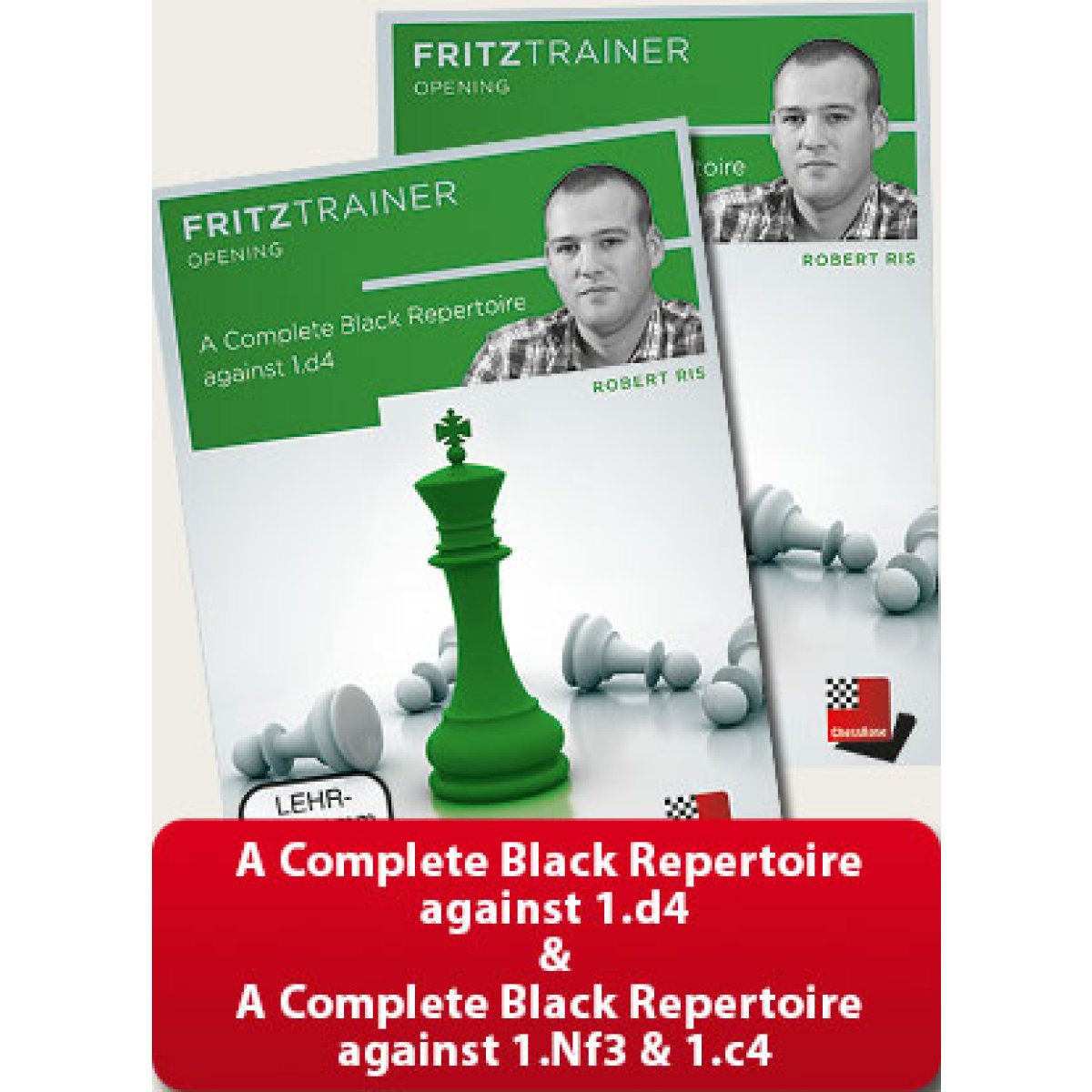

A Complete Black Repertoire against 1.d4, 1.Nf3 & 1.c4
search
  • A Complete Black Repertoire against 1.d4, 1.Nf3 & 1.c4

A Complete Black Repertoire against 1.d4, 1.Nf3 & 1.c4

€54.90
Tax included
Master the openings 1.d4, 1.Nf3, and 1.c4 with this complete repertoire for Black based on the Accepted Queen's Gambit Defense. It includes 14 hours of video, interactive exercises, and databases with model games. Learn dynamic and aggressive lines to challenge White and seize the initiative from the opening.

FORMAT: DOWNLOAD
This product is not provided in physical format. You will receive an email from our store with the download link and product activation code.

Quantity
In Stock

  Security policy

(edit with the Customer Reassurance module)

  Delivery policy

(edit with the Customer Reassurance module)

  Return policy

(edit with the Customer Reassurance module)

These video courses offer an opening repertoire for Black against 1.d4, 1.Nf3, and 1.c4. The suggested variations are easy to learn and remember, yet pose significant challenges for White.

Video Course 1

This course presents a complete and clear repertoire for Black against 1.d4, based on the Accepted Queen’s Gambit Defense (1.d4 d5 2.c4 dxc4). By capturing the d-pawn, Black seeks open play with agile development. They do not fear exchanging the central pawn; rather, their goal is to pressure White’s center and challenge the opponent. In addition to covering all critical lines after 1.d4 and 2.c4, popular systems such as Trompovsky, London/Jobava, Torre Attack, Colle System, and Veresov are included.

Against the main lines of the Accepted Queen’s Gambit, this course adopts an active approach so Black can seize the initiative. It includes 20 exercises to assess your knowledge, 10 positions for practice, and a database with over 150 model games.

• Video duration: 7 hours (English)
• Interactive training with video feedback
• Extras: database with model games and exercises using ChessBase applications to memorize the repertoire and practice key positions against Fritz at various levels

Video Course 2

This course offers a complete and accessible repertoire for Black against 1.Nf3 and 1.c4. The variations are simple to learn and remember but present significant challenges for White. Against 1.Nf3, the response is 1...d5, preparing to transition into the Accepted Queen’s Gambit if White plays 2.d4. All relevant White alternatives—2.c4, 2.e3, 2.b3, 2.g3—are analyzed in depth.

Facing the English Opening (1.c4 e5), the Grand Prix Variation with colors reversed (2...Nc6 and 3...f5) is an efficient option for club players and grandmasters alike, applicable against 2.Nc3 and 2.g3. Some lines enable Black to launch a quick attack on White’s king, while others lead to intense battles in the center. The course includes 15 exercises to evaluate your progress, 10 positions for practice, and a database with nearly 150 model games.

• Video duration: 7 hours (English)
• Interactive training with video feedback
• Extras: database with model games and exercises using ChessBase applications to memorize the repertoire and practice key positions against Fritz at various levels

The package includes:

Complete repertoire for Black against 1.d4
Complete repertoire for Black against 1.Nf3 & 1.c4
Included:
  • Fritztrainer application for Windows and Mac
  • Available for download or on DVD
  • Video course with an approximate duration of 4-8 hours
  • Integrated database with Fritztrainer games to incorporate into your repertoire via WebApp Opening or ChessBase
  • Interactive exercises with video feedback: the authors present exercises and key positions; the user must input the solution, with explanations and corrections
  • Sample games in ChessBase database
  • New: many Fritztrainers also available for streaming on the ChessBase video portal
Features of the FritzTrainer application:
  • Videos playable in Fritztrainer or ChessBase with graphics, notation, and function bar
  • Analysis engine can be activated at any time
  • Video pause for navigation and manual notation analysis
  • Input of your own variations, engine analysis, and storage within the game
  • Learning variations: view specific lines in ChessBase WebApp Opening with automatic playback; memorize and practice transitions (starting position – final position)
  • Active opening training: selected positions are transferred to ChessBase WebApp Fritz-online to test your knowledge in games against Fritz
More options: start FritzTrainer in ChessBase:
  • Direct access to the database with all games and analysis
  • Easy addition of games to the opening reference
  • Direct evaluation with game reference, including playback on the analysis board
  • Saving and adding your own variations to your personal repertoire
  • Reproduction training
  • Active live book
  • Use of all engines installed in ChessBase for analysis
  • Assisted analysis
  • Printing notation and diagrams for exercises

Sample Video

Contents

    Complete repertoire for Black against 1.d4

  • Introduction
  • Main line of the Accepted Queen’s Gambit: 3.e4 e5
  • 1.d4 d5 2.c4 dxc4 3.e4 e5
  • 4.Nf3 exd4 5.Bxc4 Nc6 6.Qb3 Bb4+
  • 4.Nf3 exd4 5.Bxc4 Nc6 6.O-O Be6 7.Bxe6 fxe6
  • 4.Nf3 exd4 5.Bxc4 Nc6 6.O-O Be6 7.Bb5 Bc5 Minor options
  • 4.Nf3 exd4 5.Bxc4 Nc6 6.O-O Be6 7.Bb5 Bc5 8.b4 Minor options
  • 4.Nf3 exd4 5.Bxc4 Nc6 6.O-O Be6 7.Bb5 Bc5 8.b4
  • Alternatives on move 4
  • Alternatives on move 5 after 4.Nf3 exd4
  • Deviations on the third move of the Accepted Queen’s Gambit
  • 1.d4 d5 2.c4 dxc4
  • 3.Nf3 Nf6 Introduction and Qxb7
  • 3.Nf3 Nf6 4.e3 Bg4 5.Bxc4 e6 Main ideas
  • 3.e3 e5 Introduction and minor options
  • 3.e3 e5 4.Bxc4 Nc6 5.Nf3 e4
  • 3.Nf3 Nf6 4.Nc3 Introduction and minor options
  • 3.Nf3 Nf6 4.Nc3 a6 5.e4 b5 6.e5 Nd5 7.a4 e6 Main line
  • 3.Qa4+ and 3.Nf3 Nf6 4.Qa4+ Ideas
  • Queen’s pawn openings
  • 1.d4 d5
  • Trompovsky: 2.Bg5 f6!?
  • Colle System: 2.Nf3 Nf6 3.e3 c5
  • Torre Attack: 2.Nf3 Nf6 3.Bg5 Ne4
  • London System: 2.Bf4 c5 and 2.Nf3 Nf6 3.Bf4 c5
  • Veresov and Jobava System: 2.Nc3 Nf6 3.Bg5/Bf4
  • Blackmar-Diemer Gambit: 2.e4 dxe4 3.Nc3 Nf6 4.f3 c5
  • Conclusion
  • Exercises 01-10
  • Exercise 01
  • Exercise 02
  • Exercise 03
  • Exercise 04
  • Exercise 05
  • Exercise 06
  • Exercise 07
  • Exercise 08
  • Exercise 09
  • Exercise 10
  • Exercises 11-20
  • Exercise 11
  • Exercise 12
  • Exercise 13
  • Exercise 14
  • Exercise 15
  • Exercise 16
  • Exercise 17
  • Exercise 18
  • Exercise 19
  • Exercise 20

    Complete repertoire for Black against 1.Nf3 & 1.c4

  • Introduction
  • 1.Nf3 d5
  • 1.Nf3 d5
  • 2.c4 d4 3.b4 c5 Secondary variations
  • 2.c4 d4 3.b4 c5 Main line
  • 2.c4 d4 3.e3 Nc6
  • 2.c4 d4 3.g3 Nc6 4.Bg2 e5 without d3
  • 2.c4 d4 3.d3 Nc6 4.Bg2 e5 5.g3
  • Inverted Ben-Oni: 2.e3 c5 3.c4 d4 4.exd4 cxd4 5.d3 Nc6 6.g3 e5
  • 2.e3 c5 3.b3 Nf6 4.Bb2 g6 5.c4 dxc4 6.Bxc4 Bg7 – g6 setup
  • 2.b3 c5 3.Bb2 f6
  • Reti: 2.g3 Nc6 Introduction
  • Reti: 2.g3 Nc6 3.d4 Bf5 4.Bg2 Nb4 5.Na3 e6 Main line
  • 1.c4 e5
  • 1.c4 e5
  • 2.Nc3 Nc6 3.Nf3 f5 4.d4 e4 Alternatives on move 5
  • 2.Nc3 Nc6 3.Nf3 f5 4.d4 e4 5.Ng5 Bb4
  • Grand Prix Variation with colors reversed: 2.Nc3 Nc6 3.g3 f5 4.Bg2 Nf6 5.d3 Bb4
  • 2.Nc3 Nc6 3.g3 f5 4.Bg2 Nf6 5.e3 e4
  • Main English line – New idea: 2.Nc3 Nc6 3.g3 f5 4.Nf3 Nf6 5.d4 e4
  • Conclusion
  • Exercises
  • Exercise 01
  • Exercise 02
  • Exercise 03
  • Exercise 04
  • Exercise 05
  • Exercise 06
  • Exercise 07
  • Exercise 08
  • Exercise 09
  • Exercise 10
  • Exercise 11
  • Exercise 12
  • Exercise 13
  • Exercise 14
  • Exercise 15

Accepted Queen’s Gambit Defense

An alternative is 2...dxc4, the Accepted Queen’s Gambit. Black resolves the central tension created by 2.c4 by capturing off-center, leaving White with a pawn majority in the center (d and e pawns versus Black’s single e-pawn). However, it is impossible for Black to hold the c4-pawn, so this is not a gambit in the strictest sense. The usual reply for White is 3.e4, forming an “ideal center” with pawns on d4 and e4. Black will try to attack this center with pawns and pieces, aiming to force a pawn exchange or advance, choosing among 3...c5, 3...e5, 3...Nc6, and 3...Nf6, which can lead to early complications.

ACBRA11&1-KBTN