

FORMAT: DOWNLOAD
This product is not supplied in physical format. You will receive an email from our store with the download link and product activation code.
 Security policy
(edit with the Customer Reassurance module)
 Delivery policy
(edit with the Customer Reassurance module)
 Return policy
(edit with the Customer Reassurance module)
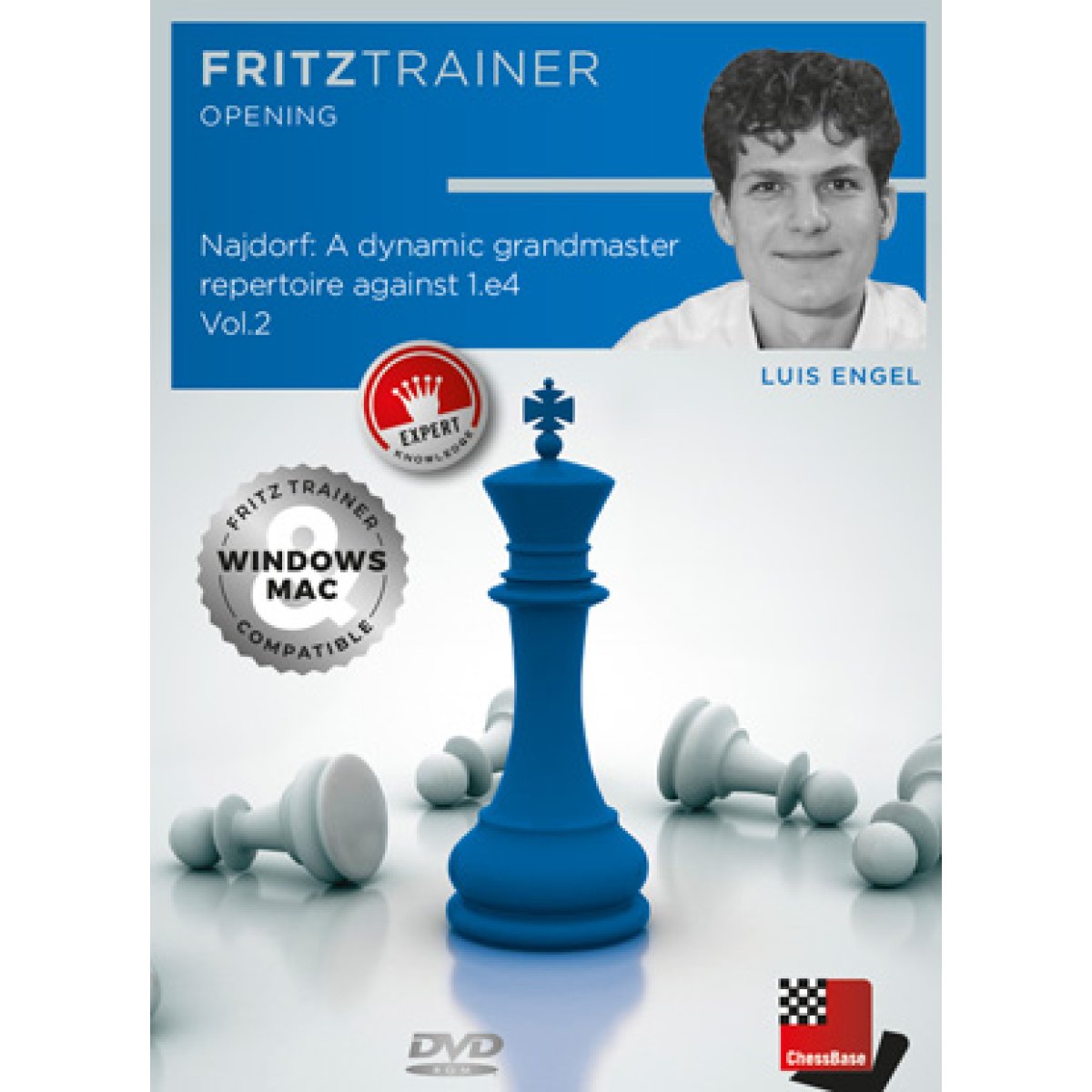
This two-part Fritztrainer offers you a complete repertoire to face all the responses White has tried against the Najdorf on move 6, following the opening moves 1. e4 c5 2. Nf3 d6 3. d4 cxd4 4. Nxd4 Nf6 5. Nc3 a6.
The Najdorf Variation combines aggressive chess with deep strategic plans, offering something for every type of player. No clear methods have yet been found for White to obtain an advantage in the opening, which is why it is considered one of the strongest and most popular openings.
The second part of this video series analyzes all the other moves White has employed on the sixth move, mainly 6. h3, but also options like 6. g3, 6. Rg1, and others. Additionally, this Fritztrainer includes more than 20 playable positions and tactical exercises that reinforce the key positions and motifs of the repertoire. With the opening application, you can assess how much you remember of the presented theory.
It is surprising that the most important system in the Sicilian begins with a seemingly harmless move like 5...a6. This rook pawn advance does not contribute immediately to development but prevents White's pieces from occupying the b5 square and prepares a counterattack on the queenside with ...b7-b5. Sometimes ...b4 is threatened to expel the knight on c3, exerting pressure on the e4 pawn. Thus, 5...a6 is preparation to attack White's center.
The rise of the Najdorf Variation — named after the Polish-Argentine grandmaster Miguel Najdorf (1910–1997) — began in the 1950s. World champions such as Petrosian, Tal, and Fischer employed it, and Kasparov was feared for his mastery of the sharp lines of the Najdorf.
FORMAT: DOWNLOAD
This product is not supplied in physical format. You will receive an email from our store with the download link and product activation code.