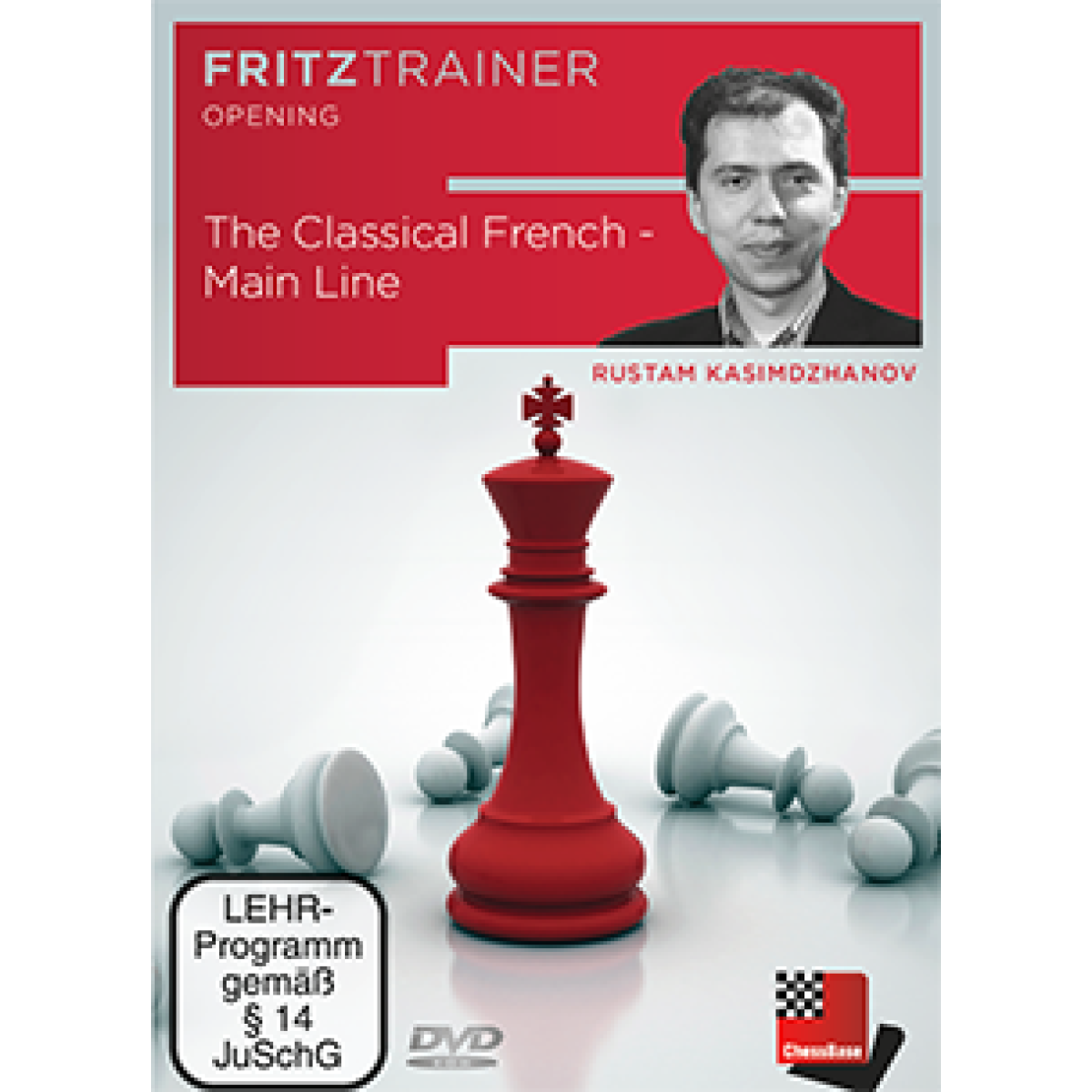


The Classical French - Main Line
search
  • The Classical French - Main Line

The Classical French - Main Line

€29.90
Tax included
Discover the most important variations of the Classical French Defense with this comprehensive 5-hour DVD. Analyze key lines after 7.Be3, from the aggressive 7...cxd4 8.Nd4 Qb6 to the more solid options with 7...Bc5 and 7...a6. Includes detailed analyses, interactive exercises with video feedback, and an exclusive database with over 50 essential games. Ideal for players looking to deepen their repertoire in this classical defense.

FORMAT: DOWNLOAD
This product is not supplied in physical format. You will receive an email from our store with the download link and product activation code.

Quantity
In Stock

  Security policy

(edit with the Customer Reassurance module)

  Delivery policy

(edit with the Customer Reassurance module)

  Return policy

(edit with the Customer Reassurance module)

This DVD explores one of the most important lines of the French Defense. After 1.e4 e6 2.d4 d5 3.Nc3 Nf6 4.e5 Nfd7 5.f4 c5 6.Nf3 Nc6 7.Be3, the author analyzes in detail a sharp line with 7... cxd4 8.Nd4 Qb6, as well as the quieter plans with 7... cxd4 8.Nd4 Bc5 and the main line with 7... a6 and b5. With thorough analyses of the most up-to-date variations and numerous new ideas for both sides, this DVD is a must-have for any French Defense player.

• Video duration: 5 hours and 5 minutes (in English)
• Interactive training with video feedback
• Exclusive database with more than 50 essential games and analysis by Kasimdzhanov
• Includes CB 12 reader

More...Less...
Included content:
  • Fritztrainer application for Windows
  • Available for download or on DVD
  • Video course with an approximate duration of 4 to 8 hours
  • Repertoire database: save and integrate Fritztrainer games into your repertoire (in WebApp Opening or ChessBase)
  • Interactive exercises with video feedback: authors present key positions and the user must enter the solution, receiving explanations and corrections
  • Example games in ChessBase database
Features of the FritzTrainer application:
  • Videos playable in the Fritztrainer app or ChessBase with board, notation, and function bar
  • Analysis engine available at any time
  • Video pause for navigation and manual analysis in the notation
  • Input and storage of personal variations with engine analysis
  • Variant learning: view specific lines in ChessBase WebApp Opening with automatic playback and practice their transformation
  • Active opening training: selected positions are transferred to ChessBase WebApp Fritz-online to play and test what you have learned
More options: launch FritzTrainer from the ChessBase program
  • Direct access to the database with all games and analyses
  • Easy incorporation of games into the opening repertoire
  • Direct evaluation with reference games and playback on the analysis board
  • Saving and adding personal variations to the personal repertoire
  • Training with game playback
  • Active LiveBook
  • Ability to use all engines installed in ChessBase for analysis
  • Assisted analysis
  • Printing of notation and diagrams for study material

Sample video

Content

  • 01: Introduction [03:12]
  • Classical French Defense: 1.e4 e6 2.d4 d5 3.Nc3 Nf6 4.e5 Nfd7 5.f4 c5 6.Nf3 Nc6 7.Be3
  • 02: 7...cxd4 8.Nxd4 Qb6 9.a3 - Nakamura line part 1 [09:57]
  • 03: 7...cxd4 8.Nxd4 Qb6 9.Qd2 Qxb2 10.Rb1 Qa3 11.Ncb5 - Nakamura line part 2 [10:09]
  • 04: 7...cxd4 8.Nxd4 Qb6 9.Qd2 Qxb2 10.Rb1 Qa3 11.Bb5 - Nakamura line part 3 [09:59]
  • 05: 7...cxd4 8.Nxd4 Qb6 9.Qd2 Qxb2 10.Rb1 Qa3 11.Bb5 Nxd4 12.Bxd4 Bb4 13.Rb3 Qa5 14.a3 Be7 15.f5 exf5 16.0-0/e6/Nxd5 - Nakamura line part 4 [12:35]
  • 06: 7...cxd4 8.Nxd4 Qb6 9.Qd2 Qxb2 10.Rb1 Qa3 11.Bb5 Nxd4 12.Bxd4 a6 - Qb2 Summary [08:24]
  • 07: 7...cxd4 8.Nxd4 Qb6 9.Qd2 Qxb2 10.Rb1 Qa3 11.Bb5 Nxd4 12.Bxd4 a6 13.Bxd7 Bxd7 14.Rb3 Qe7 15.Rxb7 Rc8 16.f5 - Qb2 Rc8 part 1 [10:27]
  • 08: 7...cxd4 8.Nxd4 Qb6 9.Qd2 Qxb2 10.Rb1 Qa3 11.Bb5 Nxd4 12.Bxd4 a6 13.Bxd7 Bxd7 14.Rb3 Qe7 15.Rxb7 Rc8 16.0-0 - Qb2 Rc8 part 2 [14:47]
  • 09: 7...cxd4 8.Nxd4 Qb6 9.Qd2 Qxb2 10.Rb1 Qa3 11.Bb5 Nxd4 12.Bxd4 a6 13.Bxd7 Bxd7 14.Rb3 Qe7 15.Rxb7 Qd8 - Qb2 Qd8 [14:10]
  • 10: 7...cxd4 8.Nxd4 Qb6 9.Qd2 Qxb2 10.Rb1 Qa3 11.Bb5 Nxd4 12.Bxd4 a6 13.Bxd7 Bxd7 14.Rb3 Qe7 15.Rxb7 Qh4+ - Qb2 Qh4 [14:05]
  • 11: 7...cxd4 8.Nxd4 Bc5 9.Qd2 0-0/Bxd4 - Thomas Luther line part 1 [12:45]
  • 12: 7...cxd4 8.Nxd4 Bc5 9.Qd2 Bxd4 10.Bxd4 Nxd4 11.Qxd4 Qb6 12.Qd2 Qxb2 - Thomas Luther line part 2 [12:17]
  • 13: 7...cxd4 8.Nxd4 Bc5 9.Qd2 0-0 10.0-0-0 Nxd4 - Kramnik-Radjabov line [11:05]
  • 14: 7...cxd4 8.Nxd4 Bc5 9.Qd2 0-0 10.0-0-0 a6 11.Nb3 - Anand-Morozevich line [11:31]
  • 15: 7...cxd4 8.Nxd4 Bc5 9.Qd2 0-0 10.0-0-0 a6 11.Qf2 Bxd4 12.Bxd4 b5 - Caruana-Meier line part 1 [11:32]
  • 16: 7...cxd4 8.Nxd4 Bc5 9.Qd2 0-0 10.0-0-0 a6 11.Qf2 Bxd4 12.Bxd4 b5 13.Be3 Qa5 14.Kb1 b4 15.Ne2 Qc7 - Caruana-Meier line part 2 [11:47]
  • 17: 7...cxd4 8.Nxd4 Bc5 9.Qd2 0-0 10.0-0-0 a6 11.Qf2 Bxd4 12.Bxd4 b5 13.Be3 Qa5 14.Kb1 b4 15.Ne2 Qc7 16.Nd4 Nxd4 17.Bxd4 a5 18.Bb5/Rd3 - Caruana-Meier line part 3 [14:16]
  • 18: 7...a6 8.Qd2 b5 - a6-b5 Summary [08:42]
  • 19: 7...a6 8.Qd2 b5 9.dxc5 Bxc5 10.Bd3 - a6-b5 Karjakin line [10:12]
  • 20: 7...a6 8.Qd2 b5 9.Bd3 - a6-b5 Bd3 line [14:55]
  • 21: 7...a6 8.Qd2 b5 9.Nd1 - a6-b5 Nd1 line [11:37]
  • 22: 7...a6 8.Qd2 b5 9.a3 Bb7 - a6-b5 Bb7 line [08:10]
  • 23: 7...a6 8.Qd2 b5 9.a3 g5 - a6-b5 g5 Morozevich line [10:42]
  • 24: 7...a6 8.Qd2 b5 9.a3 Qb6 - a6-b5 Qb6 line [10:30]
  • 25: 7...a6 8.Qd2 b5 9.a3 Qa5 - a6-b5 Qa5 line [13:11]
  • 26: Conclusion [01:05]
  • Test positions
  • 27: Position 1 [02:24]
  • 28: Position 2 [01:43]
  • 29: Position 3 [01:28]
  • 30: Position 4 [01:11]
  • 31: Position 5 [01:51]
  • 32: Position 6 [01:18]
  • 33: Position 7 [01:26]
  • 34: Position 8 [00:49]
  • 35: Position 9 [01:34]
  • 36: Position 10 [01:27]
  • 37: Position 11 [01:34]
  • 38: Position 12 [01:44]
  • 39: Position 13 [01:22]
  • 40: Position 14 [01:30]
  • 41: Position 15 [01:46]
More...
Less...

French Defense

The French Defense arises when Black responds to White's king pawn double advance with 1...e6. Its name comes from a correspondence match between London and Paris in 1834, where the French successfully employed this move. In the 19th century, it was the main alternative for Black against 1...e5 and today it remains the third most popular reply to 1.e4, after the Sicilian Defense and 1...e5.

TCF-ML-GNRZ