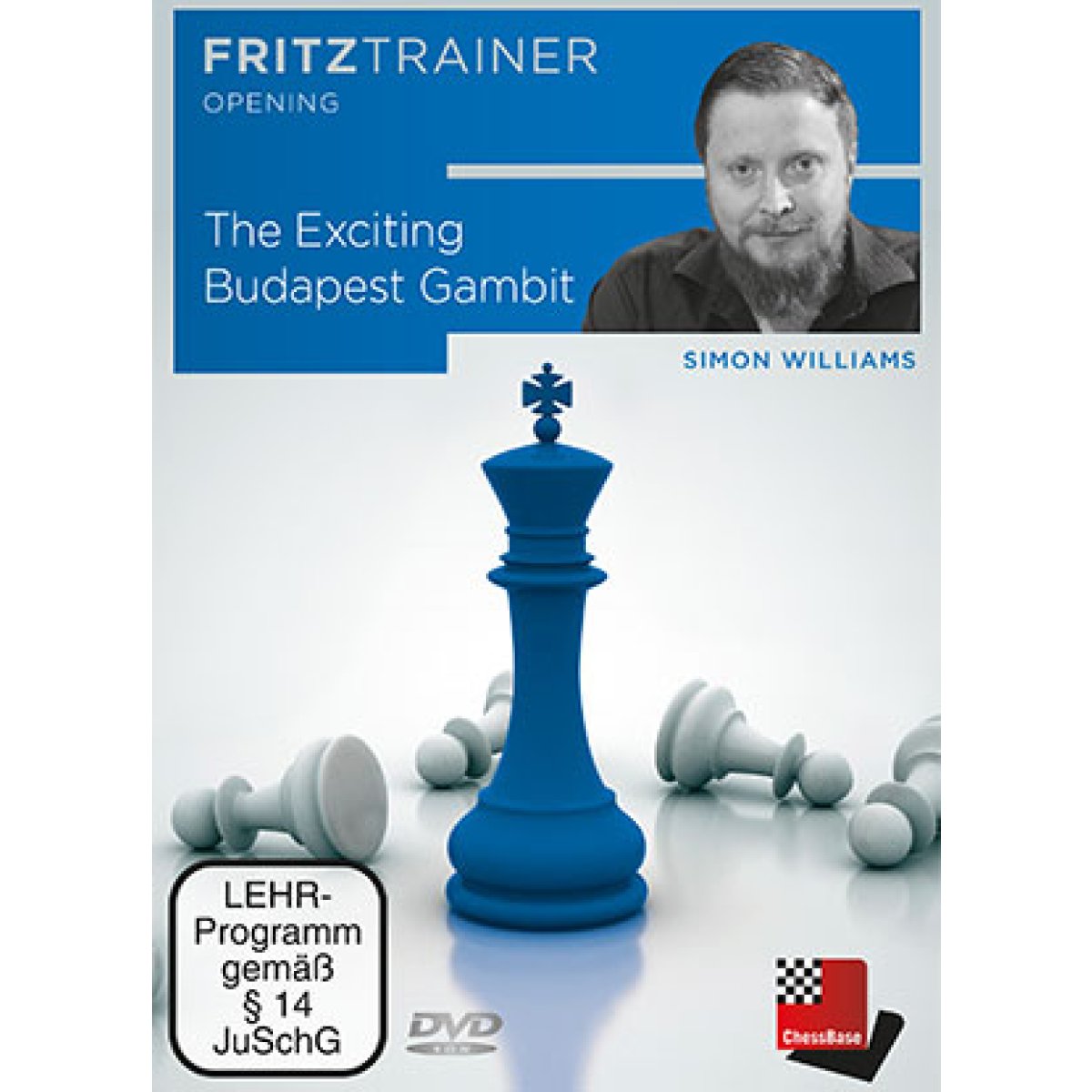


The Exciting Budapest Gambit
search
  • The Exciting Budapest Gambit

The Exciting Budapest Gambit

€29.90
Tax included
Discover the Budapest Gambit, a dynamic and surprising opening against 1.d4 and 2.c4 with 1...Nf6 and 2...e5. In this 6-hour video course, explore its traps, variations, and key strategies with interactive exercises and detailed analysis. Includes a database with model games and repertoire training to improve your play and surprise your opponents with this underrated chess gem.

FORMAT: DOWNLOAD
This product is not provided in physical format. You will receive an email from our store with the download link and product activation code.

Quantity
In Stock

  Security policy

(edit with the Customer Reassurance module)

  Delivery policy

(edit with the Customer Reassurance module)

  Return policy

(edit with the Customer Reassurance module)

The Budapest Gambit is an exciting and entertaining way to respond to 1.d4 and 2.c4 by playing 1...Nf6 and 2...e5. In this video, you will learn how to pose challenges for White with this fascinating opening. Exploring the strength of this defense has been a passionate journey for me. When I first became interested in this underrated opening, I knew very little, but now books and articles about it take up much of my workspace. Then the fun began: while analyzing this material, I discovered the beauty and solidity of the Budapest Gambit, and I was surprised at how effective it really is. In this DVD, I share my findings with you. Join me on this journey to discover the strength of the Budapest Gambit.

• Video duration: 6 hours (in English)
• Interactive training with video feedback
• Database with model games
• Bonus: additional chapter with repertoire and playing functions

More... Less...
Included content:
  • Fritztrainer application for Windows and Mac
  • Available for download or on DVD
  • Video course with an approximate duration of 4-8 hours
  • Repertoire database: save and integrate Fritztrainer games into your repertoire (in WebApp Opening or ChessBase)
  • Interactive exercises with video feedback: authors present exercises and key positions; the user must enter the solution with explanations and error correction
  • Example games in database for ChessBase
  • New: many Fritztrainers also available for streaming on the ChessBase video portal
FritzTrainer application features:
  • Videos can be played in the Fritztrainer app or in ChessBase with board, notation, and function bar
  • Analysis engine available at any time
  • Video pause for manual navigation and analysis in the game notation
  • Input of own variations, engine analysis, and storage in the game
  • Learning variants: visualization of specific lines in ChessBase WebApp Opening with automatic playback, memorization, and transformation practice (starting position - final position)
  • Active opening training: selected positions are transferred to ChessBase WebApp Fritz-online to practice the opening in games against Fritz
More features when launching FritzTrainer in ChessBase:
  • Direct access to the database with all games and analyses
  • Easily add games to the opening reference
  • Direct evaluation with game reference and playback on the analysis board
  • Save and add your own variations to your personal repertoire
  • Playback training
  • Active LiveBook
  • Use all engines installed in ChessBase for analysis
  • Assisted analysis
  • Printing of notation and diagrams for study materials

Sample Video

Content

  • Introduction
  • Introduction
  • Introduction to games and strategic themes
  • (Chapter title)
  • Introductory game 1
  • Introductory game 2
  • Introductory game 3
  • Introductory game 4
  • The big central pawn center of White
  • The Budapest rook
  • Bb4+
  • Pressure on the e4 square
  • The c4-c5 advance by White
  • Typical traps in the Budapest Gambit
  • Description
  • Kieninger Trap
  • Kieninger Trap in the Fajarowicz
  • The Dlugy Trap
  • The cheap attempt
  • The Fajarowicz Trap
  • The Alekhine Trap
  • Direct attack!
  • The greedy queen
  • Adler Variation 4.Nf3
  • (Chapter title)
  • 1.d4 Nf6 2.c4 e5 3.dxe5 Ng4 4.Nf3
  • Introduction to the Adler variation
  • Introductory game 1
  • Introductory game 2
  • Introductory game 3
  • Budapest theory 4.Nf3
  • Rubinstein Variation 4.Bf4
  • (Chapter title)
  • 1.d4 Nf6 2.c4 e5 3.dxe5 Ng4 4.Bf4
  • Introduction to the Rubinstein variation
  • Introductory game 1
  • Introductory game 2
  • Introductory game 3
  • Introductory game 4
  • Theory 4.Bf4 g5 and introduction
  • Theory 4.Bf4 Bb4+ 5.Nc3
  • Theory 4.Bf4 Bb4+ 5.Nd2 Main line
  • Alekhine Variation 4.e4
  • Description
  • 1.d4 Nf6 2.c4 e5 3.dxe5 Ng4 4.e4 Nxe5 5.f4
  • Introduction to the Alekhine variation
  • Introductory game 1
  • Introductory game 2
  • Introductory game 3 and theory 5...Nec6
  • Theory 5...Ng6
  • Side variations and Fajarowicz Gambit 3...Ne4
  • Description
  • Introduction to side variations
  • Introductory game 1
  • Side variations theory
  • 1.d4 Nf6 2.c4 e5 3.dxe5 Ne4
  • Introduction to the Fajarowicz Gambit
  • Introductory game 1
  • Fajarowicz Gambit theory
  • Conclusion
  • Exercises
  • Description
  • Test 1
  • Test 2
  • Test 3
  • Test 4
  • Test 5
  • Test 6
  • Test 7
  • Test 8
  • Test 9
  • Test 10
  • Test 11
  • Test 12
  • Test 13
  • Test 14
  • Test 15
  • Repertoire training
  • Description
  • Adler Variation 3...Ng4 4.Nf3
  • Rubinstein Variation 3...Ng4 4.Bf4
  • Alekhine Variation 3...Ng4 4.e4
  • Side variations
  • Fajarowicz Variation 3...Ne4
  • Positions for practice
  • Description
  • 1.d4 Nf6 2.c4 e5 3.dxe5 Ng4 4.Nf3 Bc5 5.e3 Nc6 6.Nc3 O-O 7.a3 a5 8.Be2 Ngxe5 9.Nxe5 Nxe5 10.O-O
  • 1.d4 Nf6 2.c4 e5 3.dxe5 Ng4 4.Nf3 Bc5 5.e3 Nc6 6.Be2 O-O 7.O-O Ngxe5 8.Nc3
  • 1.d4 Nf6 2.c4 e5 3.dxe5 Ng4 4.Bf4 Nc6 5.Nf3 Bb4+ 6.Nbd2 Qe7 7.a3 Ngxe5 8.Nxe5 Nxe5 9.e3 Bxd2+ 10.Qxd2
  • 1.d4 Nf6 2.c4 e5 3.dxe5 Ng4 4.Bf4 Nc6 5.Nf3 Bb4+ 6.Nbd2 Qe7 7.a3
  • 1.d4 Nf6 2.c4 e5 3.dxe5 Ng4 4.Bf4 Nc6 5.Nf3 Bb4+ 6.Nc3 Qe7 7.Qd5 Bxc3+ 8.bxc3 f6 9.exf6 Nxf6 10.Qd3 d6 11.e3 O-O 12.Be2
  • 1.d4 Nf6 2.c4 e5 3.dxe5 Ng4 4.Bf4 Nc6 5.Nf3 Bb4+ 6.Nbd2 Qe7 7.a3 Ngxe5 8.Nxe5 Nxe5 9.e3 Bxd2+ 10.Qxd2 d6 11.Be2
  • 1.d4 Nf6 2.c4 e5 3.dxe5 Ng4 4.Bf4 Nc6 5.Nf3 Bb4+ 6.Nc3 Bxc3+ 7.bxc3 Qe7 8.Qd5 f6 9.exf6 Nxf6 10.Qd3 d6 11.g3 O-O 12.Bg2 Bg4 13.O-O Rae8 14.Rae1 Kh8 15.Nd4
  • 1.d4 Nf6 2.c4 e5 3.dxe5 Ng4 4.Bf4 Bb4+ 5.Nd2 Nc6 6.Ngf3 Qe7 7.e3 Ngxe5 8.Nxe5 Nxe5 9.a3 Bxd2+ 10.Qxd2 d6 11.Qc3 f6 12.Be2 O-O 13.b4
  • 1.d4 Nf6 2.c4 e5 3.dxe5 Ng4 4.e4 Nxe5 5.f4 Ng6 6.Be3 Bb4+ 7.Nd2 Qe7 8.Bd3 Nc6 9.Ngf3 O-O 10.O-O
  • 1.d4 Nf6 2.c4 e5 3.dxe5 Ng4 4.e4 Nxe5 5.f4 Ng6 6.Be3
  • 1.d4 Nf6 2.c4 e5 3.dxe5 Ne4 4.Nd2 Nc5 5.Ngf3 Nc6 6.g3
  • Bonus
  • Analysis
  • Interactive analysis
  • Model games
  • Repertoire
More...
Less...
TEBG-ENSL