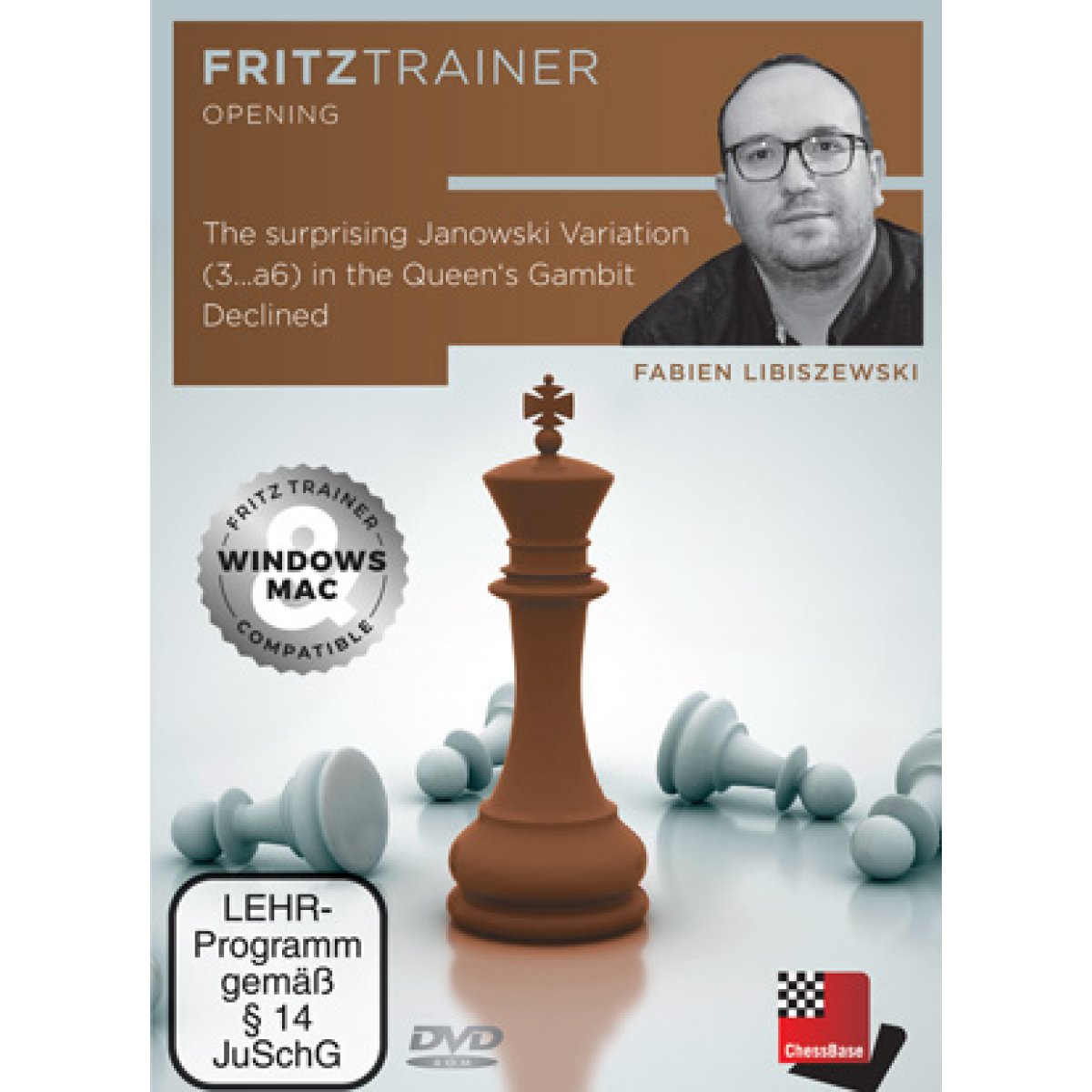


The surprising Janowski Variation  (3...a6) in the Queen‘s Gambit  Declined
search
  • The surprising Janowski Variation  (3...a6) in the Queen‘s Gambit  Declined

The surprising Janowski Variation (3...a6) in the Queen's Gambit Declined

€32.90
Tax included
Discover the powerful Janowski Variation of the Orthodox Defense in the Queen's Gambit with this comprehensive video course. Learn the key strategies and ideal responses to master this opening used by grandmasters like Magnus Carlsen. With over 6 hours of content, interactive exercises, and practical examples, you will expand your repertoire and surprise your opponents in every game. Ideal for players of all levels.

FORMAT: DOWNLOAD
This product is not provided in physical format. You will receive an email from our store with the download link and product activation code.

Quantity
In Stock

  Security policy

(edit with the Customer Reassurance module)

  Delivery policy

(edit with the Customer Reassurance module)

  Return policy

(edit with the Customer Reassurance module)

Delve into the secrets of the powerful Janowski Variation of the Queen's Gambit Declined with this new video course. Immerse yourself in this fascinating chess opening and learn how to use it to unsettle your opponents. To understand the Janowski Variation, which arises after the moves 1.d4 d5 2.c4 e6 3.Nf3 (or 3.Nc3) a6, it is essential to grasp the essence of the position rather than memorize extensive theory.

This detailed and comprehensive video course offers an in-depth exploration of the Janowski Variation, an opening recognized for its solidity and strategic potential. Used by Magnus Carlsen and other elite grandmasters, this variation is an indispensable resource for those who want to improve their play and expand their opening repertoire. In the lessons, you will discover:

  • The key concepts and fundamental strategies that define the Janowski Variation of the Queen's Gambit Declined.
  • An extensive repertoire with the different possible White responses against this variation.
  • Model games that demonstrate the success of this opening.
  • Interactive exercises to master the variation and apply what you've learned.

Whether you are a beginner looking for new ideas or an advanced player aiming to incorporate new openings, this video course is a valuable tool to enrich your arsenal. After completing it, the Janowski Variation will no longer be a mystery, and you will be ready to surprise your opponents at the board.

  • Total video duration: 6 hours and 30 minutes
  • Training with ChessBase applications
  • Memorize the repertoire and practice key positions against Fritz at different levels

Included Content:

  • FritzTrainer application for Windows and Mac
  • Available for download or on DVD
  • Video course with an approximate duration of 4 to 8 hours
  • Repertoire database: save and integrate FritzTrainer games into your personal repertoire (in WebApp Opening or ChessBase)
  • Interactive exercises with video feedback: the authors present exercises and key positions; the user must enter the solution with explanations and video corrections
  • Example games in a ChessBase database
  • New: many FritzTrainer courses now also available for streaming on the ChessBase video portal

Features of the FritzTrainer Application:

  • Videos play in the FritzTrainer app or in the ChessBase program with board graphics, notation, and function bar
  • The analysis engine can be activated at any time
  • Pause video for navigation and manual analysis in the game notation
  • Input of own variations, engine analysis, and storage in the game
  • Learning variations: viewing specific lines in ChessBase WebApp Opening with automatic playback, memorization, and practice of transformations (starting position - final position)
  • Active opening training: selected positions are transferred to ChessBase WebApp Fritz-online to play against Fritz and test your new knowledge

More Possibilities When Using FritzTrainer in ChessBase:

  • Direct access to the database with all games and analyses
  • Easy incorporation of games into the opening repertoire
  • Direct evaluation with reference to games; playback on the analysis board
  • Saving own variations to add them to the personal repertoire
  • Playback training
  • Active LiveBook
  • Use of all engines installed in ChessBase for analysis
  • Assisted analysis
  • Printing notation and diagrams for study materials

Sample Video

Course Content

  • Introduction
  • 3.Nf3
  • 1.d4 d5 2.c4 e6
  • 3.Nf3 a6 4.Nc3 dxc4
  • Catalan Part 1
  • Catalan Part 2
  • 3.Nf3 a6 4.e3 Nf6 Part 1
  • 3.Nf3 a6 4.e3 Nf6 Part 2
  • 3.Nf3 a6 4.Nbd2 & 4.Qc2
  • 3.Nf3 a6 4.Bg5 Be7
  • 3.Nf3 & Nc3 a6 4.c5
  • 3.Nc3 and Main Line
  • 1.d4 d5 2.c4 e6
  • 3.Nc3 a6 4.e4 dxe4 5.Nxe4 Nf6
  • 3.Nc3 a6 4.cxd5 exd5 5.Qb3
  • 3.Nc3 a6 4.cxd5 exd5 5.Bf4 Nf6 6.e3 Bd6
  • Main Line 3.Nf3 a6 4.cxd5 exd5 5.Nc3 h6
  • Model Games and Conclusion
  • Bobotsov - Petrosian
  • Portisch - Kasparov
  • Stockfish 8 - AlphaZero
  • Conclusion
  • Exercises
  • Exercise 1
  • Exercise 2
  • Exercise 3
  • Exercise 4
  • Exercise 5
  • Exercise 6
  • Exercise 7
  • Exercise 8
  • Exercise 9
  • Exercise 10
  • Exercise 11
  • Exercise 12
  • Exercise 13
  • Exercise 14
  • Exercise 15
  • Exercise 16

Queen's Gambit

Control of the center with 1.d4 is, along with 1.e4, one of the most popular ways to start a game. If Black responds to the queen pawn with 1...d5, after 2.c4 the Queen's Gambit arises. Generally, Black supports the pawn on d5 to maintain central presence, either with 2...e6 – the Queen's Gambit Declined – or 2...c6 – the Slav Defense. A third distinct option is 2...dxc4, the Queen's Gambit Accepted.

TSJV(ITQGD-BLJA