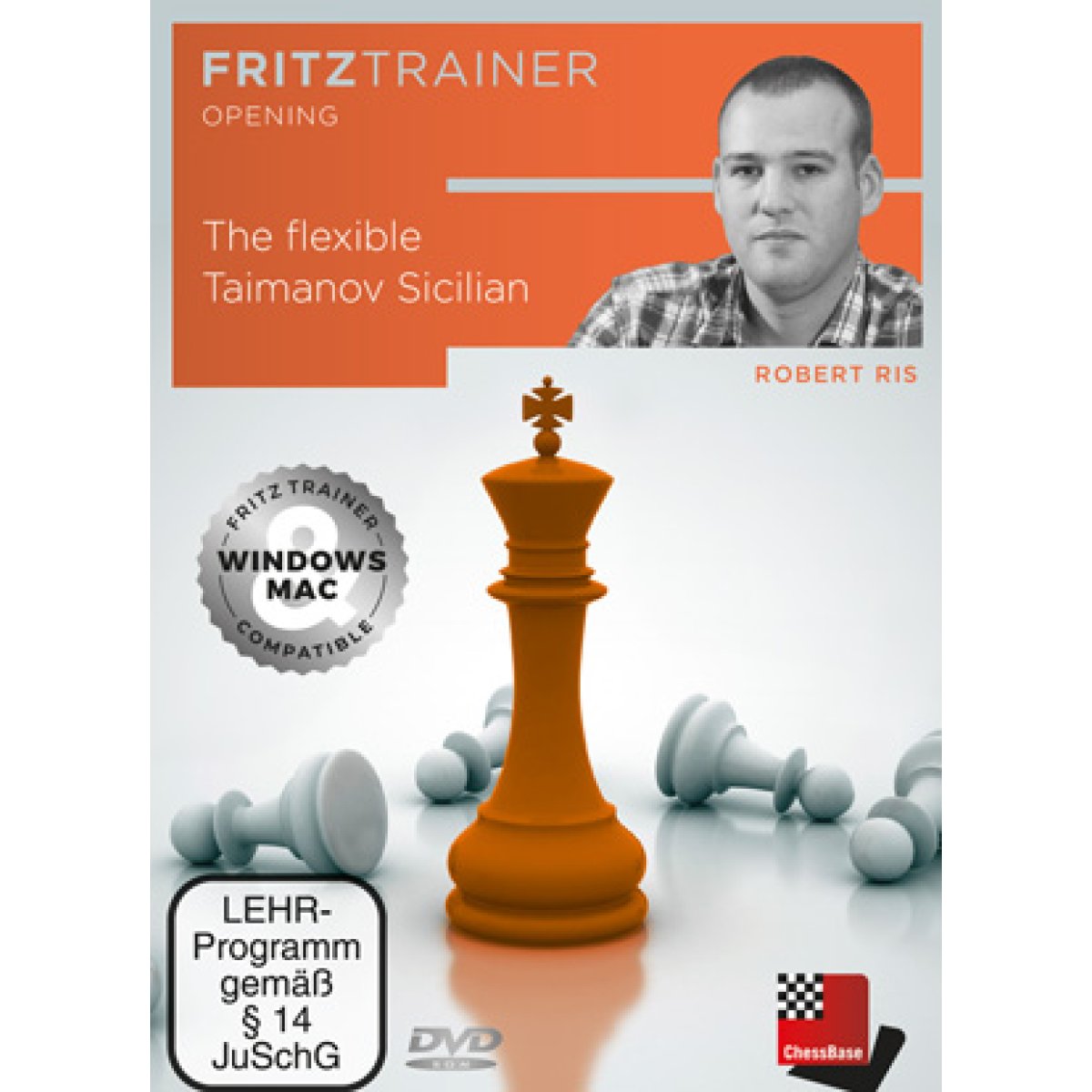


The flexible Taimanov Sicilian
search
  • The flexible Taimanov Sicilian

The flexible Taimanov Sicilian

€49.90
Tax included
Discover the solidity and flexibility of the Taimanov Sicilian Defense with this comprehensive video course. Learn a detailed repertoire for playing Black against 1.e4, based on the line 1.e4 c5 2.Nf3 e6 3.d4 cxd4 4.Nxd4 Nc6. With over 9 hours of content, interactive exercises, and a database of more than 200 model games, you will master this reliable and dynamic strategy to neutralize White's attack and achieve advantageous positions.

FORMAT: DOWNLOAD
This product is not supplied in physical format. You will receive an email from our store with the download link and product activation code.

Quantity
In Stock

  Security policy

(edit with the Customer Reassurance module)

  Delivery policy

(edit with the Customer Reassurance module)

  Return policy

(edit with the Customer Reassurance module)

Are you looking for a realistic way to play Black against 1.e4 without taking unnecessary risks? The Sicilian Taimanov Defense is a reliable system and one of the best options available. This video course offers you a complete repertoire for Black against the Open Sicilian: 1.e4 c5 2.Nf3 e6 3.d4 cxd4 4.Nxd4 Nc6.

Free sample video: Introduction

Free sample video: 5.Nxc6

Compared to many other main Sicilian variations, the Taimanov Variation is a flexible option that does not require memorizing long and forced lines to maintain balance. The goal is to reach a playable position from the opening that allows you to outplay your opponent in the long run. Thanks to its solid structure, Black's position is almost impregnable, and White players attempting quick attacks often fail. The classical lines, the latest trends, and less common attempts are covered thoroughly, avoiding unpleasant surprises. The course includes 20 exercises to test your theoretical and practical knowledge, 10 positions to practice and improve understanding of these types of positions, as well as a database with over 200 model games.

  • Total video duration: more than 9 hours
  • Interactive training with video feedback
  • Bonus: Train with ChessBase applications – memorize the repertoire and play key positions against Fritz at various levels
More... Less...
Included content:
  • Fritztrainer application for Windows and Mac
  • Available for download or on DVD
  • Video course with an approximate duration of 4 to 8 hours
  • Repertoire database: save and integrate Fritztrainer games into your repertoire (in WebApp Opening or ChessBase)
  • Interactive exercises with video feedback: the authors present exercises and key positions; the user must enter the solution, receiving explanations and corrections
  • Sample games in ChessBase database
  • New: many Fritztrainers also available via streaming on the ChessBase video portal
Features of the FritzTrainer application:
  • Video playback in the Fritztrainer app or ChessBase with board, notation, and function bar
  • Analysis engine activatable at any time
  • Video pause for manual navigation and analysis in the game notation
  • Input of personal variations and engine analysis, saved in the game
  • Variation learning: display of specific lines in WebApp Opening with automatic playback, memorization, and practice of transformations
  • Active opening training: selected positions are transferred to ChessBase WebApp Fritz-online to play against Fritz and put what you’ve learned into practice
More possibilities: launch FritzTrainer from ChessBase
  • Direct opening of the database with all games and analysis
  • Easy addition of games to the opening reference
  • Direct evaluation with game references and playback on the analysis board
  • Saving and adding personal variations to your personal repertoire
  • Playback training
  • Active LiveBook
  • Use of all engines installed in ChessBase for analysis
  • Assisted analysis
  • Printing notation and diagrams for worksheets

Sample video

Contents

  • Introduction
  • Alternatives on the fifth move
  • 1.e4 c5 2.Nf3 e6 3.d4 cxd4 4.Nxd4 Nc6
  • 5.Nxc6
  • 5.Be3
  • 5.g3
  • 5.c4
  • 5.Nb5 d6 6.Bf4
  • 5.Nb5 d6 6.c4
  • 5.Bf4
  • Alternatives on the sixth move
  • 1.e4 c5 2.Nf3 e6 3.d4 cxd4 4.Nxd4 Nc6 5.Nc3 Qc7
  • 6.Ndb5
  • 6.Ncb5
  • 6.Qd3
  • 6.g3 a6 7.Bg2 Nf6 - Secondary variations
  • 6.g3 a6 7.Bg2 Nf6 8.0-0 Nxd4 9.Qxd4 Bc5 10.Bf4 d6 11.Qd2 h6 12.Rad1 e5 13.Be3 Bxe3 - Main line
  • 6.f4
  • 6.Be3
  • 1.e4 c5 2.Nf3 e6 3.d4 cxd4 4.Nxd4 Nc6 5.Nc3 Qc7 6.Be3 a6
  • 7.f4
  • 7.Be2 b5 - Secondary variations
  • 7.Be2 b5 8.Nxc6 Qxc6 9.0-0 Bb7 10.a3 Rc8 11.Qd2
  • 7.a3
  • 7.Bd3
  • 7.Qd2 Nf6 8.f4
  • 7.Qd2 Nf6 8.0-0-0 Be7 9.f4
  • 7.Qd2 Nf6 8.0-0-0 Be7 9.f3 b5 10.g4 Nxd4 11.Qxd4
  • 7.Qd2 Nf6 8.0-0-0 Be7 9.f3 b5 10.g4 Nxd4 11.Bxd4
  • 7.Qf3 h5!?
  • 6.g4 and 6.Be3 a6 7.g4
  • 6.Be2
  • 1.e4 c5 2.Nf3 e6 3.d4 cxd4 4.Nxd4 Nc6 5.Nc3 a6 6.Be2
  • 6...a6 and 6...Nf6 7.Ndb5
  • 6...Nf6 7.0-0
  • 6...Nf6 7.Be3
  • Exercises 1-10
  • Exercise 1
  • Exercise 2
  • Exercise 3
  • Exercise 4
  • Exercise 5
  • Exercise 6
  • Exercise 7
  • Exercise 8
  • Exercise 9
  • Exercise 10
  • Exercises 11-20
  • Exercise 11
  • Exercise 12
  • Exercise 13
  • Exercise 14
  • Exercise 15
  • Exercise 16
  • Exercise 17
  • Exercise 18
  • Exercise 19
  • Exercise 20
  • Conclusion
  • Repertoire training
  • Alternatives on the fifth move
  • Alternatives on the sixth move
  • 6.Be3
  • 6.Be2
  • Positions to practice
  • 5.Nxc6
  • 5.Nb5 d6 6.c4 Nf6 7.N1c3 a6
  • 5.Nc3 Qc7 6.Nbd5 Qb8 7.Be3 a6 8.Bb6 axb5 9.Nxb5
  • 5.Nc3 Qc7 6.g3
  • 5.Nc3 Qc7 6.Be3 a6 7.Be2
  • 5.Nc3 Qc7 6.Be3 a6 7.a3
  • 5.Nc3 Qc7 6.Be3 a6 7.Qd2 Nf6 8.0-0-0 Be7 9.f4 b5 10.e5
  • 5.Nc3 Qc7 6.Be3 a6 7.Qd2 Nf6 8.f3 Be7 9.0-0-0 b5
  • 5.Nc3 Qc7 6.Be3 a6 7.Qd2 Nf6 8.f3 b5 9.g4 Bb7 10.0-0-0 Nxd4
  • 5.Nc3 Qc7 6.Be3 a6 7.Qf3 h5
  • Bonus
  • Analysis
  • Model games
  • Exercises
More...
Less...

Paulsen / Taimanov

In many Sicilian variations, Black’s kingside bishop is blocked early by ...d7-d6, usually placed on e7 and performing defensive functions such as protecting the d6 pawn or freeing the knight on f6. However, in the complex of variations around 2...e6, Black foregoes ...d6 and keeps the bishop’s diagonal open. Black develops with moves like ...a6, ...Nc6, ...Qc7, ...Nf6, and ...b5, choosing the best square for the bishop depending on White’s setup. This group includes the Kan Variation, the Paulsen System, and the Taimanov System, all characterized by great flexibility and variety in move orders. Grandmasters such as Vassily Ivanchuk and World Champion Viswanathan Anand employ these systems.

TFTS-GRWR