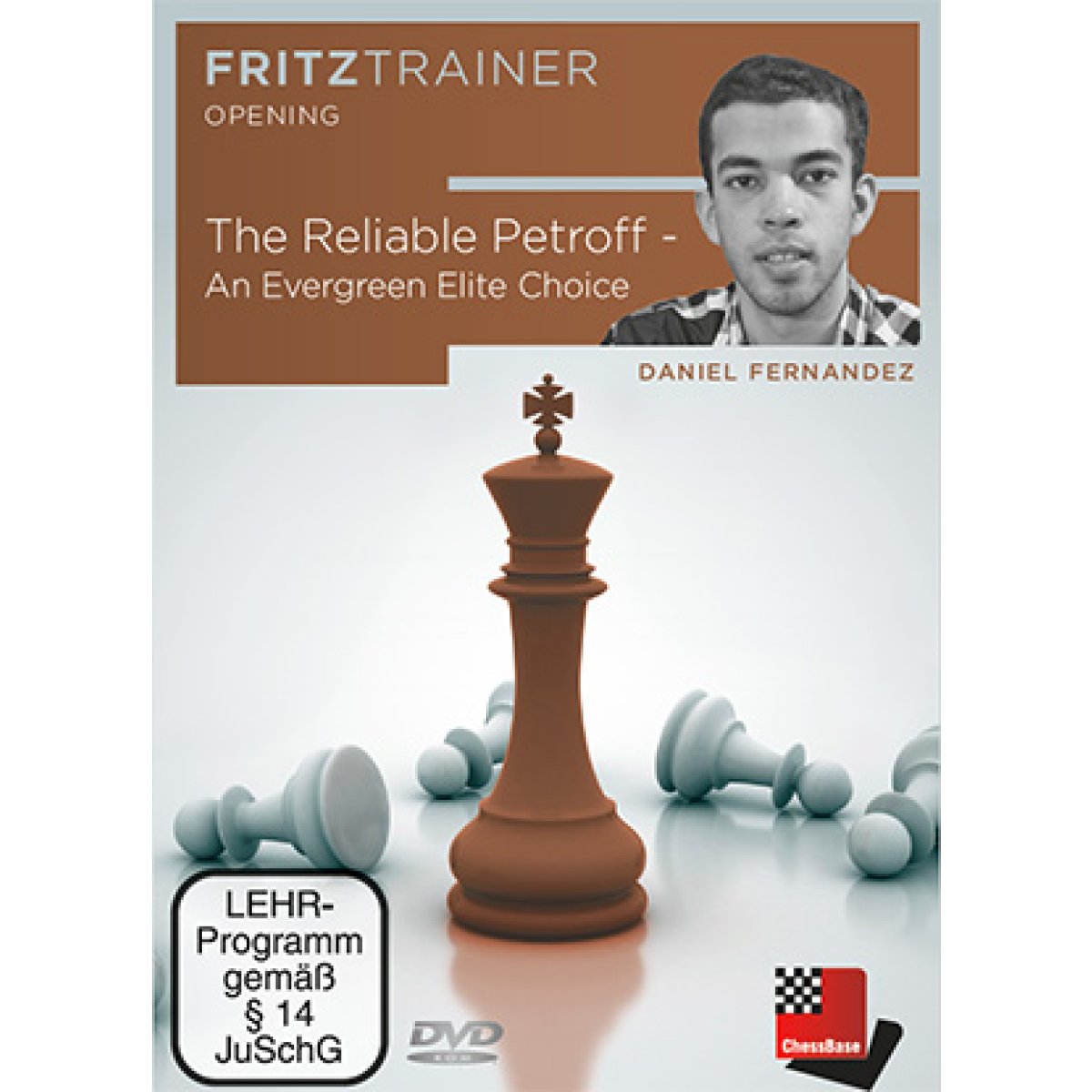


The Reliable Petroff
search
  • The Reliable Petroff

The Reliable Petroff

€29.90
Tax included
Discover the Petroff Defense with Fabiano Caruana, a solid opening popular among elites like Kasparov and Kramnik. This video course, with over 5 hours of content in English, offers detailed analyses, interactive training, and a database with model games. Ideal for those looking to understand and master this classic defense with clear explanations and practical exercises, accessible via the Fritztrainer App or DVD.

FORMAT: DOWNLOAD
This product is not supplied in a physical format. You will receive an email from our store with the download link and product activation code.

Quantity
In Stock

  Security policy

(edit with the Customer Reassurance module)

  Delivery policy

(edit with the Customer Reassurance module)

  Return policy

(edit with the Customer Reassurance module)

Caruana's favorite line - 1.e4 e5 2.Nf3 Nf6!
A consistent choice of the elite

The Petroff Defense (or Russian Defense), characterized by the moves 1.e4 e5 2.Nf3 Nf6, has been popular at the highest levels for many years and is recognized as an extremely solid defense. In the 1990s and 2000s, its theory evolved rapidly thanks to players like Kasparov, Karpov, Anand, Adams, and Kramnik, who contributed new ideas for both White and Black pieces.

Adams and Kramnik continue to use the Petroff, and they have been joined by the 2018 World Championship challenger, Fabiano Caruana. As with many openings favored by the world elite, there is a marked contrast between secondary lines, where understanding is key, and main lines, which require experience, knowledge of plans, and a high degree of concrete knowledge. This DVD presents this knowledge in a structured way so that players can select exactly what they need, combining it with analysis of structures and annotated games. Two structures are examined in detail, and the author proposes two relatively minor lines for Black that can solve practical problems or objectives that have arisen in recent games in the 5.d4 and 5.Nc3 lines.

• Video duration: 5 h 29 min (in English)
• Interactive training with video feedback
• Bonus: database with model games
• Includes CB Reader

More... Less...
Included content:
  • Fritztrainer application for Windows
  • Available for download or on DVD
  • Video course with approximate duration between 4 and 8 hours
  • Repertoire database: save and integrate Fritztrainer games into your own repertoire (in WebApp Opening or ChessBase)
  • Interactive exercises with video feedback: authors present exercises and key positions for the user to input the solution, with explanations and corrections on video
  • Example games in ChessBase database
FritzTrainer application features:
  • Watch videos in the Fritztrainer application or in ChessBase with board, notation, and function bar
  • Analysis engine available at all times
  • Video pauses for navigation and manual analysis in the notation
  • Input your own variations with engine analysis and save them in the game
  • Learn variations: view specific lines in ChessBase WebApp Opening with autoplay, memorize and practice transformations (from initial to final position)
  • Active opening training: selected positions transfer to ChessBase WebApp Fritz-online to play against Fritz and test new knowledge
More options: start FritzTrainer in ChessBase
  • Direct access to the database with all games and analyses
  • Easy addition of games to the opening reference
  • Direct evaluation with game reference and playback on the analysis board
  • Own variations saved and added to the personal repertoire
  • Playback training
  • Active LiveBook
  • Use of all engines installed in ChessBase for analysis
  • Assisted analysis
  • Printing notation and diagrams for worksheets

Sample video

Contents

  • 01: Introduction and overview [10:02]
  • Part I: Minor lines
  • 01: 3.Nc3 Bb4 4.Nxe5 d6 - Video notation [04:57]
  • 02: 3.d4 Nxe4 4.dxe5 d5 5.Bd3/Nbd2 - Video notation [15:49]
  • 03: 3.d4 Nxe4 4.Bd3 Nc6 5.d5/dxe5/Nxe5 - Video notation [17:16]
  • 04: 3.d4 Nxe4 4.Bd3 Nc6 5.Bxe4 - Video notation [17:03]
  • 05: Surprises - 3.Nxe5 Nxe4 4.Qe2 Qe7 5.Qxe4 d6 and 3.Nxe5 d6 4.Nxf7 Kxf7 - Video notations [13:44]
  • 06: 3.Nxe5 d6 4.Nc4 Nxe4 5.Qe2 Qe7 - Video notation [13:10]
  • Part II: Minor systems with d4
  • 01: 5.Qe2/d3 - Video notation [08:48]
  • 02: 5.c4 Nc6 - Video notation [15:16]
  • 03: 5.d4 d5 6.Bd3 Be7 7.O-O Nd6 Part 1 - Video notation [15:55]
  • 04: 5.d4 d5 6.Bd3 Be7 7.O-O Nd6 Part 2 - Video notation [08:03]
  • Part III: Old main line
  • 01: 10.a3 and Nc3 Be6 - Video notation [15:39]
  • 02: 10.Nc3 Bf5 - Video notation [16:12]
  • 03: Kasparov,G - Adams,M - 10.a3 Nc6 11.cxd5 Qxd5 12.Nc3 Nxc3 13.bxc3 Bf5 14.Re1 Rfe8 15.Bf4 Rac8 16.c4 Qe4 [12:26]
  • 04: Leko,P - Kramnik,V - 10.Nc3 Bf5 11.a3 Nxc3 12.bxc3 Nc6 13.Re1 Re8 14.cxd5 Qxd5 15.Bf4 Rac8 16.Bd3 Qd7 [08:38]
  • Part IV: Currently trending lines
  • 01: 5.Bd3 Nf6 - Video notation [11:10]
  • 02: 5.Nc3 Nf6 6.d4 Be7 - Video notation [17:52]
  • 03: 5.Nc3 Nxc3 6.dxc3 Be7 - Video notation [09:53]
  • Part V: Games
  • 01: Giri,A - Hou,Y - 1.e4 e5 2.Nf3 Nf6 3.Nxe5 d6 4.Nf3 Nxe4 5.Nc3 Nxc3 6.dxc3 Be7 7.Be3 Nc6 8.Bd3 Be6 [07:20]
  • 02: Hou,Y - Wei,Y - 1.e4 e5 2.Nf3 Nf6 3.Nxe5 d6 4.Nf3 Nxe4 5.Nc3 Nxc3 6.dxc3 Be7 7.Be3 Nc6 8.Qd2 Be6 [07:04]
  • 03: Kramnik,V - Caruana,F - 1.e4 e5 2.Nf3 Nf6 3.Nxe5 d6 4.Nf3 Nxe4 5.Qe2 Qe7 6.Nc3 Nxc3 7.dxc3 Qxe2 8.Bxe2 Nc6 [08:31]
  • 04: Short,N - Fernandez,D - 1.e4 e5 2.Nf3 Nf6 3.Nxe5 d6 4.Nf3 Nxe4 5.d4 d5 6.Bd3 Be7 7.O-O Nd6 [07:39]
  • 05: Carlsen,M - Karjakin,S - 1.e4 e5 2.Nf3 Nc6 3.Bb5 Nf6 4.O-O Nxe4 5.Re1 Nd6 6.Nxe5 Be7 7.Bf1 Nxe5 8.Rxe5 O-O 9.d4 Bf6 10.Re1 Re8 11.Bf4 Rxe1 12.Qxe1 Ne8 [13:09]
  • Part VI: Test section
  • 01: Cochrane Theory [03:01]
  • 02: Theoretical note 3.d4 [04:17]
  • 03: 3.d4 pawn sacrifice line [01:10]
  • 04: Attempt 7.Nbd2 [02:02]
  • 05: Typical White combination 7...Nd6 [03:18]
  • 06: Queenside break [01:32]
  • 07: 9.c5 [03:51]
  • 08: 16.Bc4 [03:21]
  • 09: 19.d5 by Kramnik [01:57]
  • 10: Topalov's game note [01:59]
  • 11: 9...Qa5 [04:20]
  • 12: Key tactic 14.Bf4 [00:43]
  • 13: Main line 10.Nc3 [03:58]
  • 14: Exchange maneuver [01:23]
  • 15: MVL-Giri [02:03]
  • 16: Pawn protection [01:14]
  • 17: Short's decision [01:48]
  • 18: Caruana's decision [04:54]
  • 19: Adams' decision [02:56]
  • 20: Fridman's decision [04:12]
More...
Less...

Petroff Defense

After 2.Nf3, Black is not forced to defend the e-pawn. Instead, they can play 2...Nf6 to launch a counterattack on White's e4 pawn. In the 19th century, the Russians Alexander Petroff (1794–1867) and Carl Friedrich Jänisch (1813–1872) made important contributions to the development of this variation, which is named after them.

In the second half of the 20th century, after a period of neglect, the variation was established in the 1980s as one of the most reliable ways for Black to achieve a draw at the elite level. Great players such as Karpov, Yusupov, Gelfand, Kramnik, and Anand adopted it, making it even more challenging for White to gain an advantage against the Petroff.

TRP-PTCS