

FORMAT: DOWNLOAD
This product is not supplied in physical format. You will receive an email from our store with the download link and product activation code.
 Security policy
(edit with the Customer Reassurance module)
 Delivery policy
(edit with the Customer Reassurance module)
 Return policy
(edit with the Customer Reassurance module)
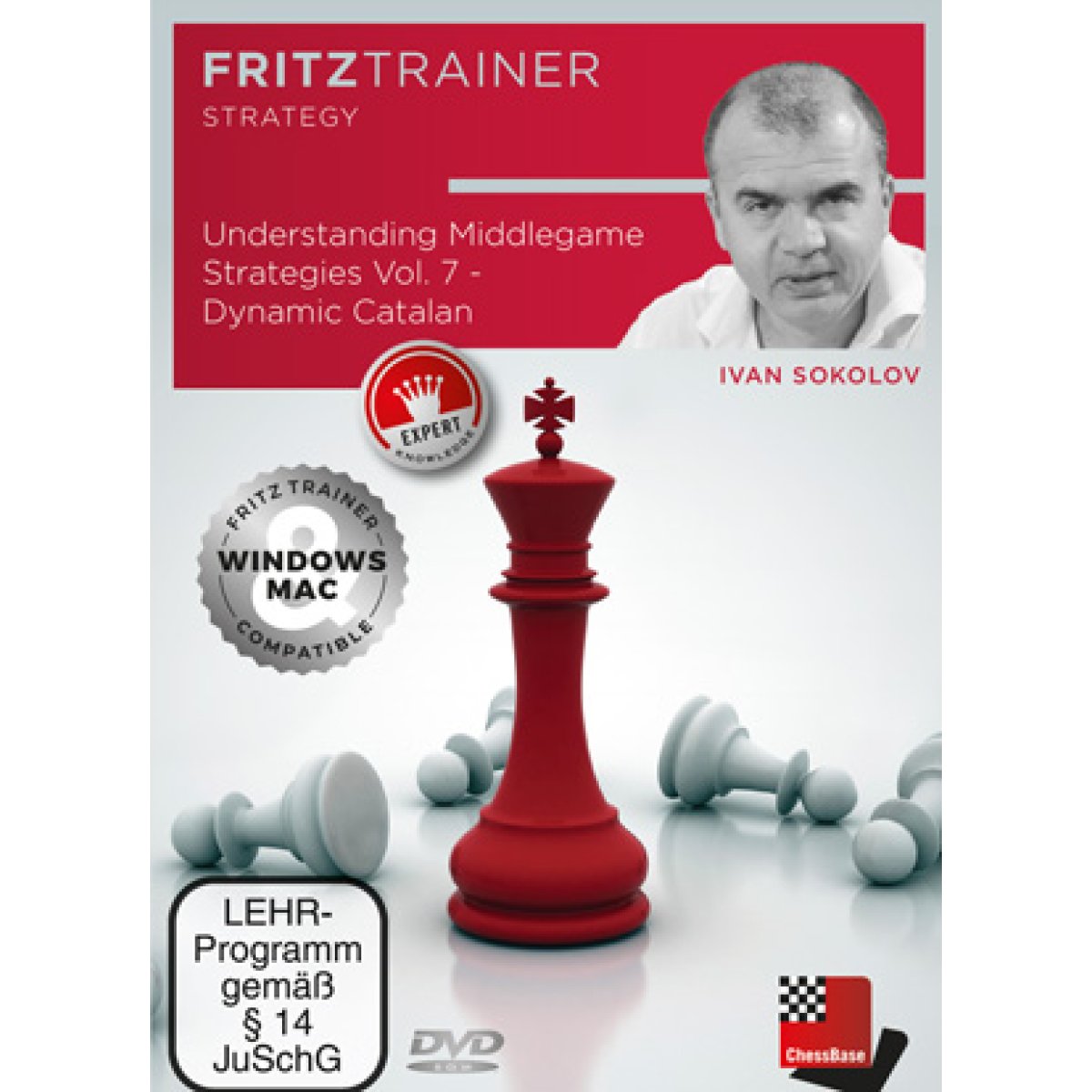
Many young elite players prefer the current and popular "Dynamic Catalan," where, against triangle or semi-Slav structures, White can sacrifice a pawn to gain immediate initiative. This sacrifice can translate into a long-term positional advantage, but frequently White launches dangerous threats against the Black king through central pawn breaks.
Many games become attacking adventures for White, with multiple opportunities to sacrifice material and generate surprising threats. The "Dynamic Catalan" can be your favorite opening if you want to take control of the game from the very first move; with this video course, you will add a sharp weapon to your repertoire. The author, Grandmaster Ivan Sokolov, has played many high-level games with White in this opening, facing players like Caruana and Vallejo Pons, and states he "feels comfortable playing: space, initiative, safe king."
If White combines the characteristic moves of the Queen's Gambit with the fianchetto of the kingside bishop, the result is the Catalan Opening. Although this structure appeared earlier, it was not named as such until 1929 after a tournament in Barcelona, the capital of Catalonia. Today, the Catalan is very popular at the highest level, with decisive victories by Kramnik (2006 in Elista) and Anand (2010 in Sofia) in their world championship matches against Topalov.
A characteristic of the Catalan is the strong pressure exerted by the bishop on the h1-a8 diagonal from g2. However, the price is that the c4 pawn is less protected than in the Queen's Gambit; in many variations, White even offers to sacrifice it. Black must decide whether to capture the c4 pawn early with their d-pawn (usually on move 4) or later (usually on move 6), or if they prefer to support the center with ...c6. If they choose the Open Catalan with 4...dxc4, then 5.Qa4+ with immediate pawn recovery is considered relatively harmless, since after 5...Nbd7 6.Qxc4 the queen's position on c4 can be used for rapid queenside development with 6...a6 7.Bg2 b5 8.Nc2 Bb7. Black will achieve ...c5 without problems and reach equality.
Thanks to modern engines, nowadays it seems you can play the Catalan – d4, c4, Nf3, g3, Bg2, etc. – almost against any defense. Of course, you can play the Catalan against the classical ...d5, ...e6, ...Nf6 structure, but also against the Slav Defense with ...Bf5 or, and this is the topic of Grandmaster Ivan Sokolov's new middlegame course, against the semi-Slav/triangle/Noteboom structure with ...e6, ...c6 and an early ...dxc4 capture.
FORMAT: DOWNLOAD
This product is not supplied in physical format. You will receive an email from our store with the download link and product activation code.