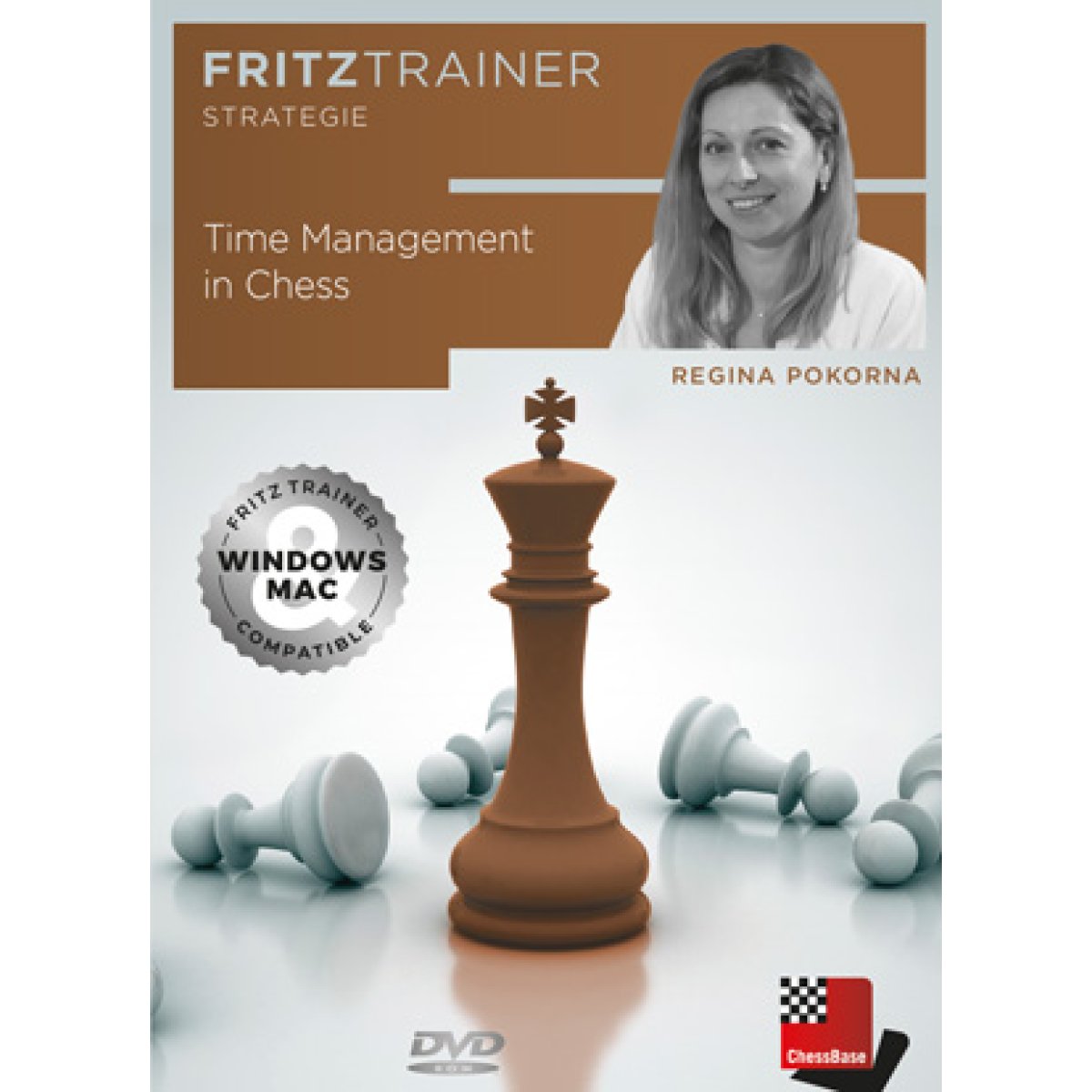

Time Management in Chess
search
  • Time Management in Chess

Time Management in Chess

€34.90
Tax included
Improve your time management in chess with this comprehensive video course of over 7 hours. Learn how to avoid clock pressure through techniques such as a solid opening repertoire, chess intuition, and prophylactic thinking. Additionally, discover how to react in time trouble situations, control your emotions, and find the best moves even in complex positions. Includes interactive exercises, video feedback, and a PDF with the best practices.

FORMAT: DOWNLOAD
This product is not provided in physical format. You will receive an email from our store with the download link and product activation code.

Quantity
In Stock

  Security policy

(edit with the Customer Reassurance module)

  Delivery policy

(edit with the Customer Reassurance module)

  Return policy

(edit with the Customer Reassurance module)

We have all experienced the stress caused by lack of time in our chess games. The clock is ticking, anxiety grows, and we make moves we wouldn’t consider if we had more time. From winning to losing, all the effort vanishes due to poor time management. The worst part is that this mistake repeats over and over again.

Time trouble is one of the most common bad habits among chess players. Although it’s unavoidable to spend time on complex positions, there are other factors such as insufficient opening preparation, perfectionism, or lack of confidence. In this video course, I will help you manage your time during the game, how to avoid this situation, and how to act when there’s no other choice. The course is divided into two parts: the first presents methods and techniques to prevent time trouble, such as a strict opening repertoire, intelligent use of chess intuition, identification of critical moments, choosing among several possible moves, prophylactic thinking, and how to avoid perfectionism in chess. The second part focuses on time trouble situations, how players of different levels and experience solve their problems on the board, and why many (including strong grandmasters) fail. Topics include seeking opportunities in unfavorable positions and finding the best escapes, emotional control, complex positions, caution regarding changes in pawn structure under time pressure, and when or if it is advisable to convert positions into (pawn) endgames.

  • Video duration: 7 hours and 20 minutes
  • Interactive training with video feedback
  • Additional material: PDF of best practices
More... Less...
This includes:
  • Fritztrainer application for Windows and Mac
  • Available for download or on DVD
  • Video course with an approximate duration of 4 to 8 hours
  • Repertoire database: save and integrate Fritztrainer games into your repertoire (in WebApp Opening or ChessBase)
  • Interactive exercises with video feedback: the author presents exercises and key positions, the user must enter the solution, receiving corrections and explanations
  • Example games in the ChessBase database
  • New: many Fritztrainers also available for streaming on the ChessBase video portal
FritzTrainer application features:
  • Videos can be played in the Fritztrainer app or in the ChessBase program with board, notation, and function bar
  • Analysis engine available at any time
  • Pause video for manual navigation and analysis in the notation
  • Input of your own variations, engine analysis, and saving in the game
  • Variation learning: view specific lines in ChessBase WebApp Opening with automatic replay, memorize and practice transformations (starting position - final position)
  • Active opening training: selected positions are transferred to ChessBase WebApp Fritz-online to play games against Fritz and practice what you’ve learned
More options: start FritzTrainer within the ChessBase program
  • Direct access to the database with all games and analyses
  • Easy incorporation of games into the opening repertoire
  • Direct evaluation with game references, playback on the analysis board
  • Saving your own variations to add to your personal repertoire
  • Playback training
  • Active LiveBook
  • Use of all engines installed in ChessBase for analysis
  • Assisted analysis
  • Printing of notation and diagrams for worksheets

Sample video

Contents

  • Introduction
  • PDF - Introduction
  • PDF - Factors
  • Shengelia vs Sebenik, 2019
  • Intuition
  • What is intuition in chess?
  • Introduction
  • Smyslov vs Panov
  • Mikhalchishin vs Chernin
  • Theissl-Pokorna vs Zhukova
  • Theissl-Pokorna vs Reizniece
  • Aronian vs Anand
  • Alekhine - Junge
  • Exercise 1: Aronin vs Kholmov
  • Exercise 2: Theissl-Pokorna vs Janetschek
  • Exercise 3: Krivec vs Theissl-Pokorna
  • Exercise 4: Keres vs Smyslov
  • Critical moments
  • Identification of critical time moments during the game
  • Introduction
  • Alekhine vs Rubinstein
  • Karpov vs Korchnoi
  • Theissl-Pokorna vs Maric
  • Benjamin vs Gulko
  • Fischer vs Spassky
  • Exercise 1: Carlsen vs Nakamura
  • Exercise 2: Maroczy vs Rubinstein
  • Exercise 3: Motylev vs Polgar
  • Candidate moves
  • How to choose among several candidate moves
  • Introduction
  • Ehlvest vs Georgiev
  • Speelman vs Kasparov
  • Van Wely vs Piket
  • Yildiz vs Pokorna
  • Exercise 1: Karjakin vs Kramnik
  • Exercise 2: McShane vs Carlsen
  • Exercise 3: Korchnoi vs Karpov
  • Exercise 4: Toshkov vs Russek Libni
  • Prophylactic thinking
  • Prophylactic thinking
  • Introduction
  • Spielmann vs Nimzowitsch
  • Rubinstein vs Salwe
  • Carlsen vs Nakamura
  • Gulko vs Panno
  • Ivanovic vs Sveshnikov
  • Exercise 1: Carlsen vs Anand
  • Exercise 2: Lukin vs Yuneev
  • Exercise 3: Sax vs Partos
  • Exercise 4: Manik vs Motuz
  • Exercise 5: Smyslov vs Panov
  • Exercise 6: Reshevsky vs Kavalek
  • Perfectionism
  • Perfectionism in chess
  • Introduction
  • Nalbandyan study
  • Keres vs Filip
  • Freiman vs Kan
  • Pokorna vs Igla
  • Alekhine vs Saemisch
  • Exercise 1: Study
  • Exercise 2: Kholmov vs Jakobsen
  • Exercise 3: Pokorna vs Seps
  • Exercise 4: Schiffers vs Steinitz
  • Inferior position
  • Seeking opportunities in inferior positions
  • Introduction
  • Galliamova vs Korchnoi
  • Spassky vs Fischer
  • Motuz vs Pile
  • Theissl-Pokorna vs Schwabeneder
  • Hagarova vs Seleljo
  • Exercise 1: Hou Yifan vs Muzychuk
  • Exercise 2: Filip vs Darga
  • Exercise 3: Chekhover study
  • Exercise 4: Polugaevsky vs Zakharov
  • Exercise 5: Gulko vs Vaganian
  • Exercise 6: Reshevsky vs Lombardy
  • Pawn structure changes
  • Avoid unnecessary changes in pawn structure
  • Introduction
  • Aronian vs Grischuk
  • Pokorna vs Meier
  • Fine vs Najdorf
  • Larsen vs Portisch
  • Exercise 1: Nepomniachtchi vs Dreev
  • Exercise 2: Vitiugov vs Volokitin
  • Exercise 3: Heredia Serrano vs Theissl-Pokorna
  • Conversion to (pawn) endgames
  • Decisions for converting positions into (pawn) endgames
  • Introduction
  • Evans vs Reshevsky
  • Sax vs Szell
  • Smyslov vs Tal
  • Atalik vs Motuz
  • Exercise 1: Ponomariov vs Kramnik
  • Exercise 2: Navara vs Tkachiev
  • Exercise 3: Smyslov vs Reshevsky
  • Exercise 4: Matisons vs Alekhine
  • Complicated positions
  • Complicated and complex positions
  • Introduction
  • Polugaevsky vs Averbakh
  • Hagarova - Vavruska
  • Schleining vs Theissl-Pokorna
  • Sadilek vs Shengelia
  • Navara vs Kulaots
  • Nikolova vs Theissl-Pokorna
  • Exercise 1: Kramnik vs Aronian
  • Exercise 2: Indjic vs Shengelia
  • Exercise 3: Udovcic vs Bilek
  • Emotions
  • Keeping emotions under control and maintaining objectivity
  • Introduction
  • Fischer vs Larsen
  • Najdorf vs Tal
  • Shengelia vs Miton
  • Shengelia vs Sutovsky
  • Reizniece vs Theissl-Pokorna
  • Hagarova vs Bauma
  • Theissl-Pokorna vs Vega Gutierrez
  • Exercise 1: Ftacnik vs Shengelia
  • Exercise 2: Shengelia vs Gazik
  • Exercise 3: Sasikiran vs Bartel
  • Exercise 4: Bisguier vs Stein
  • Best practices
  • Additional clips
  • Explanation
  • Openings
  • Best practices 1
  • Best practices 2
More...
Less...
TMIC-TUDT