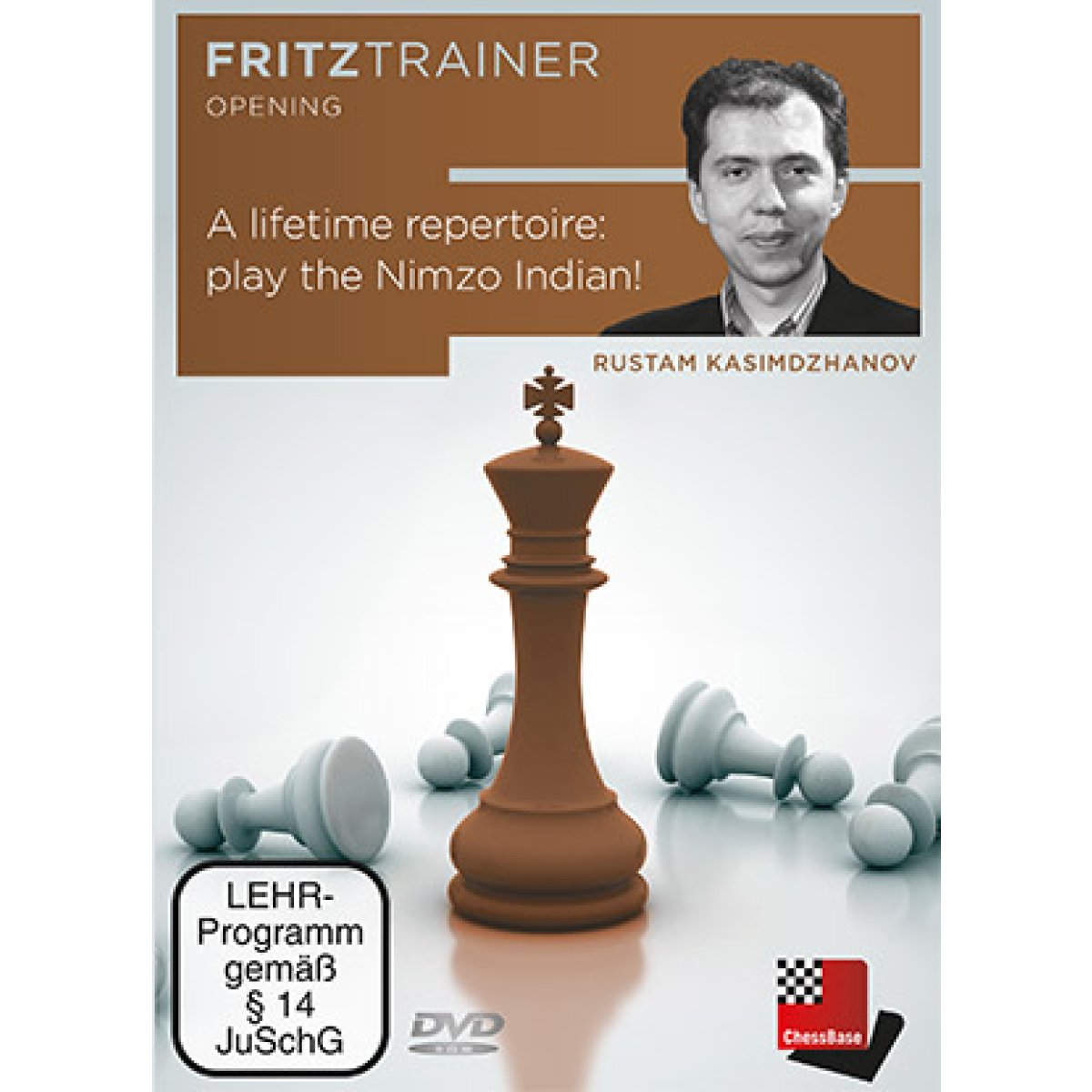


A lifetime repertoire: Play the Nimzo Indian
search
  • A lifetime repertoire: Play the Nimzo Indian

A lifetime repertoire: Play the Nimzo-Indian Defense

€29.90
Tax included
Discover the Nimzo-Indian Defense with Grandmaster Rustam Kasimdzhanov in this comprehensive DVD of nearly 7 hours. Learn classical and novel lines to surprise your opponent, with in-depth analysis and interactive exercises. Includes an exclusive database with over 50 model games and the CB reader to practice and perfect your repertoire with Black after 1.d4 Nf6 2.c4 e6 3.Nc3 Bb4.

FORMAT: DOWNLOAD
This product is not supplied in physical format. You will receive an email from our store with the download link and product activation code.

Quantity
In Stock

  Security policy

(edit with the Customer Reassurance module)

  Delivery policy

(edit with the Customer Reassurance module)

  Return policy

(edit with the Customer Reassurance module)

This DVD provides everything you need to master one of the most popular classical openings for Black: the Nimzo-Indian Defense, arising after 1.d4 Nf6 2.c4 e6 3.Nc3 Bb4. The Nimzo-Indian features prominently in nearly all World Championships and elite tournaments. It is a reliable and enduring choice for players worldwide. Former FIDE World Champion, Grandmaster Rustam Kasimdzhanov, presents both concrete variations—with numerous novelties to surprise your opponent—and positional subtleties that deepen the understanding of this opening and chess in general.

Contents:
– 4.e3 c5 followed by …b6 to reach the structure with Bb4-a5, one of the main lines.
– 4.Qc2 with 4…0-0 as the main line for Black; 4.Nf3 b6 with the idea of playing Bb7 and exchanging on c3.
– 4.f3 d5, the classical main line for Black (instead of the popular …c5).
– 4.Bg5 c5 5.d5 h6, intending to play Nbd7-b6, a system offering new and promising possibilities for Black.
– Secondary lines such as 4.g3, 4.a3, 4.Bd2 and others. If you play Nimzo-Indian with White, you will also benefit from Kasimdzhanov’s detailed analyses.

• Video duration: 6 h 47 min (in English)
• Interactive training with video feedback
• Extra: exclusive database with over 50 model games and extensive analysis by the author
• Includes CB Reader

More... Less...
Product content:
  • Fritztrainer application for Windows
  • Available for download or on DVD
  • Video course with approximate duration of 4 to 8 hours
  • Repertoire database: saves and integrates Fritztrainer games into your repertoire (in WebApp Opening or ChessBase)
  • Interactive exercises with video feedback: authors present exercises and key positions for the user to input the solution, with additional explanations and error correction
  • Example games in ChessBase database
Functions of the FritzTrainer application:
  • Videos can be played in the Fritztrainer application or ChessBase with board graphics, notation, and function bar
  • The analysis engine can be activated at any time
  • Pause videos to navigate and manually analyze the game notation
  • Input personal variations and analyze with engine, saving within the game
  • Variation learning: visualization of specific lines in ChessBase WebApp Opening with automatic playback, memorization, and practice of transformations (starting to final position)
  • Active opening training: selected positions are transferred to ChessBase WebApp Fritz-online to play against Fritz and test acquired knowledge
More possibilities: use FritzTrainer within the ChessBase program
  • Open directly the database with all games and analyses
  • Easily add games to the opening reference
  • Direct evaluation with referencing games and playback on the analysis board
  • Save personal variations and add them to the personal repertoire
  • Repetition training
  • Active LiveBook
  • Use all engines installed in ChessBase for analysis
  • Assisted analysis
  • Print notation and diagrams for study materials

Sample video

Contents

  • 01: Introduction [07:24]
  • 4.e3
  • 01: 4...b6 5.Bd3 Bb7 6.Nge2 Bxg2 7.Rg1 Be4 and 7...Bf3 8.Qc2 Nc6 – Video analysis [09:27]
  • 02: 4...b6 5.Nge2 c5 6.a3 Ba5 7.Rb1 Na6 8.Qa4 Bb7 9.f3 0-0 – Video analysis [10:28]
  • 03: 4...b6 5.Nge2 c5 6.a3 Ba5 7.Rb1 Na6 8.Qa4 Bb7 9.f3 Bc6 and 9.Bd2 Bxc3 10.Nxc3 0-0 – Video analysis [11:14]
  • 04: 4...b6 5.Nge2 c5 6.a3 Ba5 7.Bd2 0-0 – Video analysis [11:29]
  • 05: 4...b6 5.Nge2 c5 6.a3 Ba5 7.g3 Bb7 – Video analysis [11:28]
  • 06: 4...b6 5.Nge2 c5 6.a3 Ba5 7.Rb1 Na6 8.f3 0-0 and 8.Bd2 0-0 – Video analysis [11:53]
  • 07: 4...b6 5.Nge2 c5 6.a3 Ba5 7.Rb1 Na6 8.g3 Bb7 9.d5 b5 10.Bg2 bxc4 11.0-0 0-0 12.e4 exd5 13.e5 Ng4 – Video analysis [10:49]
  • 08: 4...b6 5.Nge2 c5 6.a3 Ba5 7.Rb1 Na6 8.g3 Bb7 9.d5 b5 10.Bg2 bxc4 11.0-0 0-0 12.e4 exd5 13.Nxd5/exd5 – Video analysis [08:15]
  • 09: 4...b6 5.Nge2 c5 6.a3 Ba5 7.Rb1 Na6 8.Ng3 0-0 and Bb7 9.f3/Bd3 – Video analysis [12:43]
  • 10: 4...b6 5.Nge2 c5 6.a3 Ba5 7.Rb1 Na6 8.Ng3 Bb7 9.Bd2 0-0 10.Bd3 Bxc3 and d5 11.cxd5 cxd4 12.exd4 Bxc3 13.bxc3 Re8 – Video analysis [10:16]
  • 11: 4...b6 5.Nge2 c5 6.a3 Ba5 7.Rb1 Na6 8.Ng3 Bb7 9.Bd2 0-0 10.Bd3 d5 11.cxd5 cxd4 12.exd4 Bxc3 13.bxc3 Qxd5 – Video analysis [10:51]
  • 4.Qc2
  • 01: 4.Qc2 0-0 5.Nf3 c5 6.dxc5 Na6 7.c6/a3 – Video analysis [10:45]
  • 02: 4.Qc2 0-0 5.Nf3 c5 6.dxc5 Na6 7.g3 Nxc5 8.Bg2 b6 9.0-0 Bb7 – Video analysis [09:55]
  • 03: 4.Qc2 0-0 5.e4 d5 6.e5 Ne4 7.Bd3 c5 8.cxd5 exd5 9.Nge2 cxd4 10.Nxd4 Nd7 and 8.Nge2 cxd4 9.Nxd4 Nd7 – Video analysis [10:33]
  • 04: 4.Qc2 0-0 5.e4 d5 6.e5 Ne4 7.Bd3 c5 8.Nge2 cxd4 9.Nxd4 Nd7 10.Bf4 Qh4 11.g3 Qh5 12.0-0 g5 13.cxd5/Be2 – Video analysis [11:39]
  • 05: 4.Qc2 0-0 5.Bg5 and 5.a3 Bxc3 6.Qxc3 b5 7.cxb5 c6 Secondary lines – Video analysis [12:26]
  • 06: 4.Qc2 0-0 5.a3 Bxc3 6.Qxc3 b5 7.cxb5 c6 8.Bg5 cxb5 9.Nf3 Bb7 10.e3 a6/h6 Main line Part 1 – Video analysis [11:52]
  • 07: 4.Qc2 0-0 5.a3 Bxc3 6.Qxc3 b5 7.cxb5 c6 8.Bg5 cxb5 9.e3 Bb7 10.f3 h6/a6 Main line Part 2 – Video analysis [11:03]
  • 4.Nf3 and 4.f3
  • 01: 4.Nf3 b6 5.e3 Bb7 6.Bd3 0-0 7.0-0 Bxc3 8.bxc3 d6 – Video analysis [10:47]
  • 02: 4.Nf3 b6 5.Bg5 h6 6.Bh4 g5 7.Bg3 Ne4 – Video analysis [11:46]
  • 03: 4.f3 d5 5.a3 Bxc3 6.bxc3 c5 7.e3 and cxd5 Nxd5 8.dxc5 Qa5 9.e4 Nf6 10.Be3 0-0 – Video analysis [10:03]
  • 04: 4.f3 d5 5.a3 Bxc3 6.bxc3 c5 7.cxd5 Nxd5 8.dxc5 Qa5 9.e4 Nf6 10.Be3 0-0 11.Kf2 Nfd7 12.Rb1 Rd8 – Video analysis [10:51]
  • 05: 4.f3 d5 5.a3 Bxc3 6.bxc3 c5 7.cxd5 Nxd5 8.dxc5 Qa5 9.e4 Nf6 10.Be3 0-0 11.Qb3 Nfd7 12.a4 Qc7 13.Qa3 b6 14.a5 bxc5 15.a6 c4 16.Ne2 Bxa6 and 16.Qa5 Nxa6 – Video analysis [10:25]
  • 06: 4.f3 d5 5.a3 Bxc3 6.bxc3 c5 7.cxd5 Nxd5 8.dxc5 Qa5 9.e4 Nf6 10.Be3 0-0 11.Qb3 Nfd7 12.a4 Qc7 13.Qa3 b6 14.a5 bxc5 15.a6 c4 16.Qa5 Qxa5 – Video analysis [06:57]
  • Secondary lines
  • 01: 4.Bg5 c5 5.d5 h6 6.Bh4 d6 7.e3 Bxc3 8.bxc3 Qe7 9.Bd3 – Video analysis [10:36]
  • 02: 4.Bg5 c5 5.d5 h6 6.Bh4 d6 7.e3 Bxc3 8.bxc3 Qe7 9.Nf3 – Video analysis [11:23]
  • 03: 4.Bd2 b6 5.e3 Bb7 6.Nf3 0-0 7.Bd3 d5 Part 1 – Video analysis [10:55]
  • 04: 4.Bd2 b6 5.e3 Bb7 6.Nf3 0-0 7.Bd3 d5 Part 2 – Video analysis [11:15]
  • 05: 4.a3 Bxc3 5.bxc3 b6 6.f3 Ba6 7.e4 Nc6 8.e5/Bd3/Nh3/Qa4 and 8.Bg5 Na5 9.e5 h6 10.Bh4 g5 11.Bf2 Nh5 12.h4 f5 Part 1 – Video analysis [13:04]
  • 06: 4.a3 Bxc3 5.bxc3 b6 6.f3 Ba6 7.e4 Nc6 8.Bg5 Na5 9.e5 h6 10.Bh4 g5 11.Bf2 Nh5 12.h4 f5 Part 2 – Video analysis [09:24]
  • 07: 4.g3 0-0 5.Bg2 d5 6.Qb3/a3 and 6.Nf3 dxc4 7.0-0 Nc6 8.a3/e3/Bg5 – Video analysis [12:47]
  • 08: 4.Qb3 c5 5.Nf3 Nc6 6.e3 d5 7.dxc5 0-0 and 4.Bf4 c5 5.e3 cxd4 6.exd4 0-0 – Video analysis [06:59]
  • Notable games
  • 01: 4.Nf3 0-0 5.Bg5 c5 6.e3 cxd4 7.Qxd4 Nc6 – Bai, J - Ding, L [11:14]
  • 02: 4.f3 d5 5.a3 Bxc3 6.bxc3 c5 7.cxd5 Nxd5 8.Qd3 b6 – Shirov, A - Karpov, A [08:12]
  • 03: 4.Nf3 c5 5.e3 Nc6 6.Bd3 Bxc3 7.bxc3 d6 8.e4 e5 – Spassky, B - Fischer, R [12:53]
  • 04: 4.Qc2 0-0 5.a3 Bxc3 6.Qxc3 b6 7.Bg5 Bb7 8.f3 h6 9.Bh4 d5 – Golod, V - Kasimdzhanov, R [06:46]
  • Test section
  • 01: Test 1 [01:12]
  • 02: Test 2 [01:38]
  • 03: Test 3 [01:13]
  • 04: Test 4 [01:50]
  • 05: Test 5 [01:22]
  • 06: Test 6 [02:02]
  • 07: Test 7 [01:33]
  • 08: Test 8 [00:58]
  • 09: Test 9 [01:16]
  • 10: Test 10 [01:34]
  • 11: Final [00:57]

Nimzo-Indian Defense

The Nimzo-Indian Defense enjoys an excellent reputation as a strategically active opening against 1.d4. The move 3...Bb4 was popularized by Aaron Nimzowitsch (1886–1935), who developed this system especially in the 1920s. Instead of directly occupying the center with the d-pawn (3...d5 would lead to a Queen’s Gambit Defense), Black uses their minor pieces (Nf6, Bb4) to exert pressure on the central squares e4 and d5. Initially, the pawn structure with c, d, and e pawns is not fixed. Additionally, Black threatens to weaken White’s pawn structure by exchanging on c3, which would create doubled pawns on c3/c4.

ALRPTNI-VOZZ