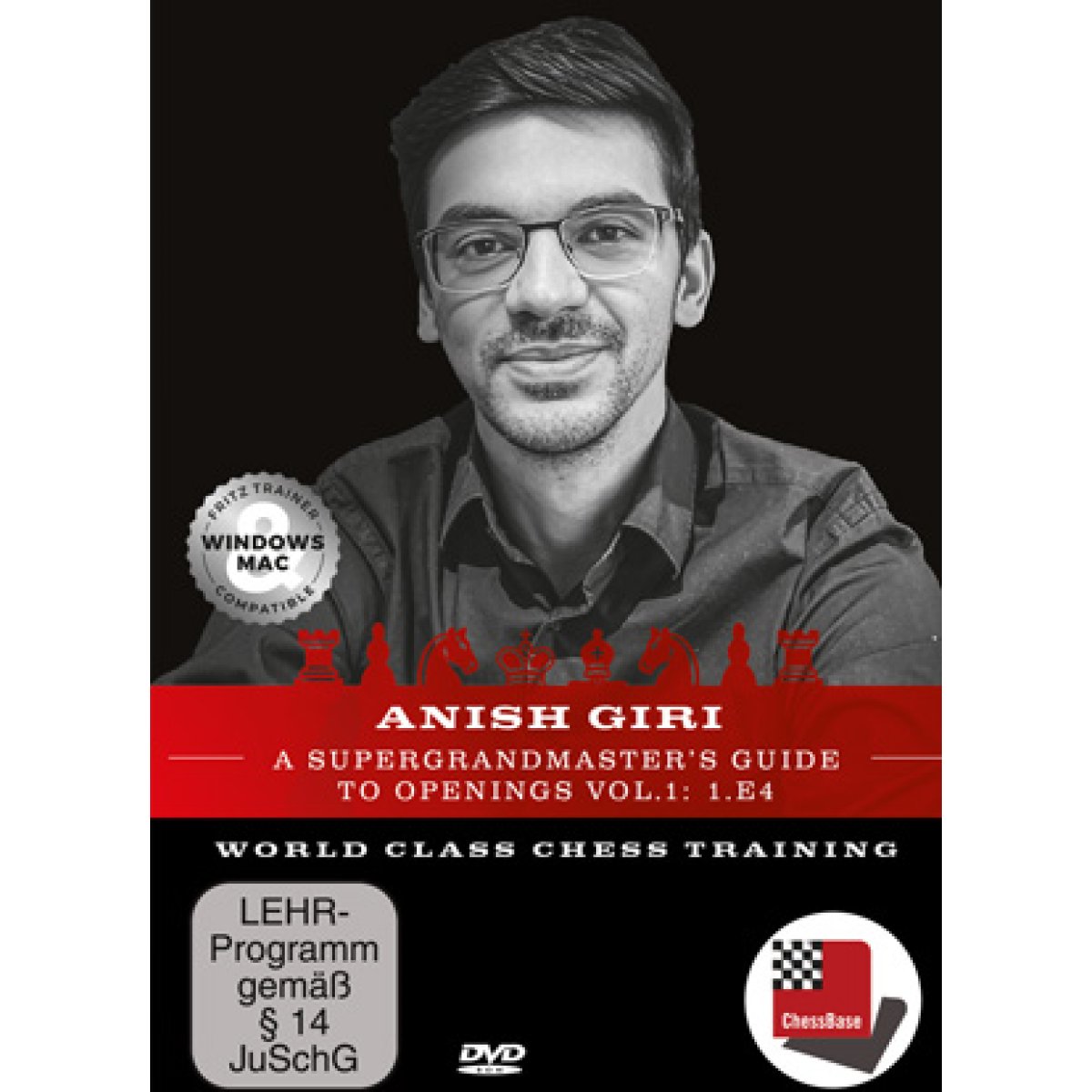


A Supergrandmaster's Guide to Openings Vol.1: 1.e4
search
  • A Supergrandmaster's Guide to Openings Vol.1: 1.e4

A Supergrandmaster's Guide to Openings Vol.1: 1.e4

€49.90
Tax included
Discover "A Supergrandmaster's Guide to Openings Vol.1" with GM Anish Giri, a video course that explores openings after 1.e4, including the Ruy López, Italian, Sicilian, and more. With deep analysis, personal stories, and interactive exercises, this guide will help you build a solid repertoire and better understand the opening phase of chess. Ideal for players who want to master openings with the insight of a world expert.

FORMAT: DOWNLOAD
This product is not supplied in physical format. You will receive an email from our store with the download link and product activation code.

Quantity
In Stock

  Security policy

(edit with the Customer Reassurance module)

  Delivery policy

(edit with the Customer Reassurance module)

  Return policy

(edit with the Customer Reassurance module)

When starting to build your opening repertoire, what better way than to see each one from the perspective of an elite grandmaster? This makes it easier to understand and develop your repertoire in the vast world of chess openings. Precisely with this idea, Opening Guide by a Super Grandmaster with Anish Giri was born.

This video course presents the deep analyses of GM Anish Giri and the key questions from IM Sagar Shah. Volume 1 covers all openings after 1.e4, including Ruy López, Italian, Petrov, Scotch, French, Sicilian, Caro-Kann, Pirc, Modern, and more. Each video explains the subtleties of the opening and Anish also shares the story of his favorite game in that line along with related memories. It is invaluable to hear the insight of one of the best opening experts in today's chess. This course will elevate your knowledge and help you make informed decisions to build your repertoire. If you have always struggled with openings, this course is the ideal starting point for the opening phase of the game.

  • Total duration: 3 hours and 19 minutes
  • Extras: Training with ChessBase apps to memorize repertoires and a database with games by Anish Giri
More... Less...
Included content:
  • Fritztrainer application for Windows and Mac
  • Available for download or on DVD
  • Video course with approximate duration of 4 to 8 hours
  • Database to save and integrate Fritztrainer games into your repertoire (in WebApp Opening or ChessBase)
  • Interactive exercises with video feedback, including analysis and detailed explanations
  • Example games in database for ChessBase
  • New: many Fritztrainers now also available for streaming on the ChessBase video portal
Features of the FritzTrainer application:
  • Video playback with board, notation, and function bar in Fritztrainer or ChessBase
  • Ability to activate analysis engine at any time
  • Pause video to navigate and manually analyze the notation
  • Input and storage of personal variations with engine analysis
  • Learning variations with automatic playback in WebApp Opening and practice of transformations
  • Active training: opening positions sent to WebApp Fritz-online to play against Fritz and test knowledge
More options when using FritzTrainer with ChessBase:
  • Direct access to the database with all games and analyses
  • Easy incorporation of games into the repertoire
  • Immediate analysis with reference to games and playback on the board
  • Saving personal variations to expand your personal repertoire
  • Reproduction training
  • Active LiveBook
  • Use of all engines installed in ChessBase for analysis
  • Assisted analysis
  • Printing notation and diagrams for teaching materials

Sample video

Contents

  • Introduction
  • Fundamentals
  • Ruy López
  • 1.e4 e5 2.Nf3 Nc6 3.Bb5
  • Ruy López - Analysis
  • Game database
  • Repertoire training
  • Description
  • For White
  • For Black
  • Italian Game
  • 1.e4 e5 2.Nf3 Nc6 3.Bc4 Bc5
  • Italian Game - Analysis
  • Game database
  • Repertoire training
  • For White
  • For Black
  • Petrov Defense
  • 1.e4 e5 2.Nf3 Nf6
  • Petrov Defense - Analysis
  • Game database
  • Repertoire training
  • For White
  • For Black
  • Scotch Game
  • 1.e4 e5 2.Nf3 Nc6 3.d4
  • Scotch Game - Analysis
  • Game database
  • Repertoire training
  • For White
  • For Black
  • More game databases
  • More repertoire training
  • Sicilian Defense
  • 1.e4 c5
  • Sicilian Defense - Analysis
  • Game database
  • Repertoire training
  • Najdorf for White
  • Najdorf for Black
  • Dragon for White
  • Dragon for Black
  • Scheveningen for White
  • Scheveningen for Black
  • Classical for White
  • Classical for Black
  • Sveshnikov/Kalashnikov for White
  • Sveshnikov/Kalashnikov for Black
  • Kan for White
  • Kan for Black
  • Closed for White
  • Closed for Black
  • Alapin for White
  • Alapin for Black
  • Rossolimo/Moscow for White
  • Rossolimo/Moscow for Black
  • French Defense
  • 1.e4 e6
  • French - Analysis
  • Game database
  • Repertoire training
  • Exchange for White
  • Exchange for Black
  • Advance for White
  • Advance for Black
  • Tarrasch for White
  • Tarrasch for Black
  • Winawer for White
  • Winawer for Black
  • Caro-Kann Defense
  • 1.e4 c6
  • Caro-Kann - Analysis
  • Game database
  • Repertoire training
  • Advance for White
  • Advance for Black
  • Main line for White
  • Main line for Black
  • Exchange for White
  • Exchange for Black
  • Alekhine/Scandinavian Defenses
  • 1.e4 Nf6/d5
  • Alekhine/Scandinavian - Analysis
  • Alekhine game database
  • Scandinavian game database
  • Repertoire training
  • Alekhine for White
  • Alekhine for Black
  • Scandinavian for White
  • Scandinavian for Black
  • Pirc/Modern/Philidor Defenses
  • 1.e4 d6/g6
  • Pirc/Modern/Philidor - Analysis
  • Pirc/Modern game database
  • Philidor game database
  • Repertoire training
  • Pirc/Modern for White
  • Pirc/Modern for Black
  • Philidor for White
  • Philidor for Black
  • Conclusion
More...
Less...

Open Openings

After 1.e4 e5, the so-called open openings arise. Previously this move was almost mandatory, and through this route some of the most famous games in history began, such as the Immortal and the Evergreen. Nowadays, beginners usually learn these openings first, where even the scholar’s mate can appear. Moreover, 1...e5 is considered the most solid counterplay and dominates high-level chess.

ASGTOV1-XTER