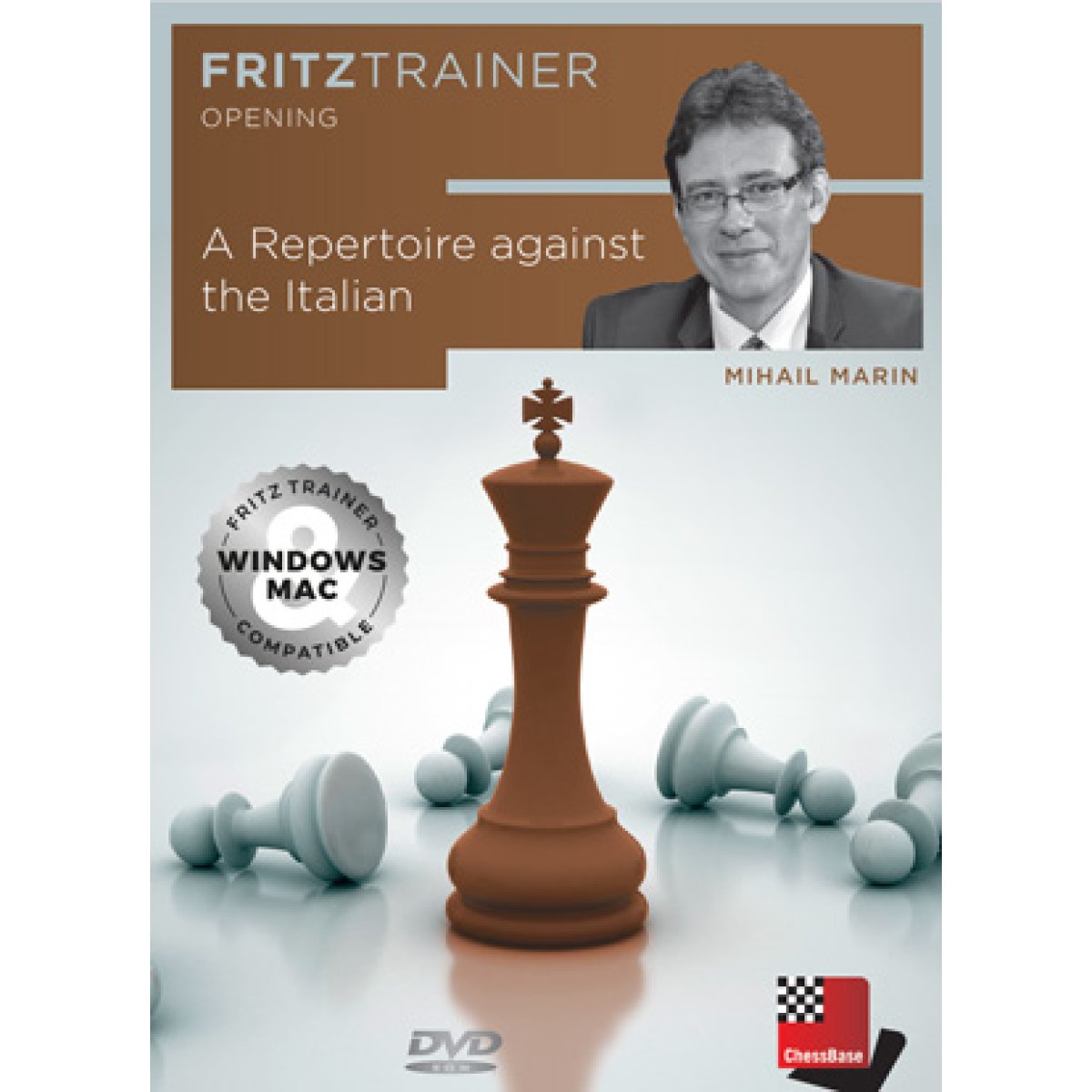


A Repertoire against  the Italian Game
search
  • A Repertoire against  the Italian Game

Un repertorio contra la Apertura Italiana

€29.90
Tax included
Discover a solid repertoire against the Giuoco Pianissimo, ideal for players looking to avoid the typical positional pressure of the Ruy López and opt for a dynamic and balanced game. This 5 hour and 30 minute video course includes effective methods to counter the Italian opening variations, with interactive exercises, a game database, and practice against Fritz at various levels. Improve your play and master this classic opening!

FORMAT: DOWNLOAD
This product is not provided in physical format. You will receive an email from our store with the download link and product activation code.

Quantity
In Stock

  Security policy

(edit with the Customer Reassurance module)

  Delivery policy

(edit with the Customer Reassurance module)

  Return policy

(edit with the Customer Reassurance module)

Due to White’s difficulty in demonstrating an advantage in various lines of the Ruy López system, the Italian Opening (also called Giuoco Piano) has gained popularity. In the variations based on an early d2-d3 (Giuoco Pianissimo), White aims to subject their opponent to positional pressure similar to that known as the “Spanish Torture,” a term used by Tartakower to describe the strategic struggle in the Ruy López.

The repertoire against the Giuoco Pianissimo analyzed in this video course offers Black methods to avoid this somewhat advantageous structure for White, achieving solid play in dynamic positions. The main idea is the move ...g5, but if White prepares to counter it, Black can switch to comfortable positional struggle variations. The second group of systems studied is characterized by White’s early central opening with d4. Black should not fear these lines and, in fact, can take advantage of them to create counterplay. This course also includes a database with all relevant games and a selection of positions for practice.

• Video length: 5 hours 30 minutes (in English)
• Interactive training with video feedback
• Extras: model game database and exercises with ChessBase applications – memorize the repertoire and play key positions against Fritz at various levels

More... Less...
Product Contents:
  • Fritztrainer application for Windows and Mac
  • Available for download or on DVD
  • Video course approximately 4 to 8 hours long
  • Repertoire database: save and integrate Fritztrainer games into your repertoire (in WebApp Opening or ChessBase)
  • Interactive exercises with video feedback: the authors present exercises and key positions, the user must enter the solution. Includes explanations and corrections
  • Sample games in ChessBase format
  • New: many Fritztrainer also available for streaming on the ChessBase video portal
Features of the FritzTrainer application:
  • Videos can be played in the Fritztrainer app or in the ChessBase program with board, notation, and function bar
  • Analysis engine can be activated at any time
  • Video pause for manual navigation and notation analysis
  • Input of own variations and engine analysis, saving changes within the game
  • Variation learning: view specific lines in ChessBase WebApp Opening with autoplay, memorize and practice transformations (starting position – final position)
  • Active opening training: selected positions are transferred to ChessBase WebApp Fritz-online to play against Fritz and test your knowledge
More options: start FritzTrainer from ChessBase
  • Direct access to the database with all games and analyses
  • Easy integration of games into your opening repertoire
  • Direct evaluation with references to games, which can be replayed on the analysis board
  • Saving and adding your own variations to your personal repertoire
  • Playback training
  • Active LiveBook
  • Use of all engines installed in ChessBase for analysis
  • Assisted analysis
  • Printing of notation and diagrams for worksheets

Sample Video

Contents

  • Introduction
  • Giuoco Pianissimo c3/d3
  • 1.e4 e5 2.Nf3 Nc6 3.Bc4 Bc5 4.c3 Nf6 5.d3 a6
  • Introduction
  • 6.0-0 d6 Secondary lines
  • 6.0-0 d6 7.Bb3
  • 6.0-0 d6 7.Bb3 Ba7 8.Re1
  • 6.0-0 d6 7.Bb3 Ba7 8.Nbd2 h6 9.h3
  • 6.0-0 d6 7.Bb3 Ba7 8.Nbd2 h6 9.Re1
  • 6.0-0 d6 7.a4 Ba7 Secondary lines
  • 6.0-0 d6 7.a4 Ba7 8.Re1
  • 6.0-0 d6 7.a4 Ba7 8.Nbd2 h6 9.b4
  • 6.0-0 d6 7.a4 Ba7 8.b4
  • 6.Nbd2 Ba7 7.Nf1/Bb3
  • 6.Nbd2 Ba7 7.Bb3 h6 8.h3
  • 5.b4 Bb6 6.d3 d6
  • Giuoco Piano c3/d4
  • 1.e4 e5 2.Nf3 Nc6 3.Bc4 Bc5 4.c3 Nf6
  • 5.d4 exd4 6.cxd4 Bb4+ 7.Kf1
  • 5.d4 exd4 6.cxd4 Bb4+ 7.Nbd2
  • 5.d4 exd4 6.cxd4 Bb4+ 7.Nc3
  • 5.d4 exd4 6.cxd4 Bb4+ 7.Bd2
  • 5.d4 exd4 6.e5 d5 Secondary lines
  • 5.d4 exd4 6.e5 d5 7.Bb5 Ne4 8.cxd4 Bb6 9.Nc3 O-O 10.h3/O-O
  • 5.d4 exd4 6.e5 d5 7.Bb5 Ne4 8.cxd4 Bb6 9.Nc3 O-O 10.Be3 Bg4 11.h3 Bh5 Secondary lines
  • 5.d4 exd4 6.e5 d5 7.Bb5 Ne4 8.cxd4 Bb6 9.Nc3 O-O 10.Be3 Bg4 11.h3 Bh5 12.Qc2 Secondary lines
  • 5.d4 exd4 6.e5 d5 7.Bb5 Ne4 8.cxd4 Bb6 9.Nc3 O-O 10.Be3 Bg4 11.h3 Bh5 12.Qc2 Bg6 13.Qb3 Ne7 14.O-O c6 15.Bd3 Nd2
  • Evans Gambit b4/c3/d4
  • 1.e4 e5 2.Nf3 Nc6 3.Bc4 Bc5 4.b4 Bxb4 5.c3 Ba5 6.d4 d6
  • Introduction
  • 7.Qb3 Qd7 8.O-O Bb6
  • 7.Qb3 Qd7 8.dxe5 Bb6
  • Secondary lines
  • 1.e4 e5 2.Nf3 Nc6 3.Bc4 Bc5
  • 4.Nc3 Nf6 5.d3 d6 Secondary lines
  • 4.Nc3 Nf6 5.d3 d6 6.Na4 Bb6 7.Nxb6 axb6 8.c3 O-O Secondary lines
  • 4.Nc3 Nf6 5.d3 d6 6.Na4 Bb6 7.Nxb6 axb6 8.c3 O-O 9.O-O h6 10.h3
  • 4.O-O Nf6 5.d4
More...
Less...

Italian Opening

The Italian Opening, which arises after 3...Bc5, is one of the oldest and is already mentioned in the 16th-century Göttingen manuscript. For centuries, it was the most popular way to begin a game, and its name honors the Italian masters who mainly sought freedom of play for their pieces and complex combinations.

White has several plans in the position shown in the diagram. One of the most aggressive, leading to open positions with many tactical possibilities, is after 4.c3 Nf6 to attempt an early initiative in the center with 5.d4. This move attacks the bishop on c5. Black’s best response is the pawn exchange with 5...exd4, but after 6.cxd4, White has a mobile and dangerous pawn duo. Here Black must play precisely. The retreat 6...Bb6 would be disadvantageous because it would allow White’s central pawns to advance. Instead, Black should respond with 6...Bb4+ to force a reaction to the check. The usual reply is 7.Bd2 Bxd2+ 8.Nbxd2, although in many open games this allows the important central counterplay 8...d5, which breaks up White’s center and gains a tempo by attacking the bishop on c4. After 9.exd5 Nxd5, the ideal d4-e4 center reduces to an isolated pawn on d4, but both sides retain broad strategic options.

ARATIG-UAWU