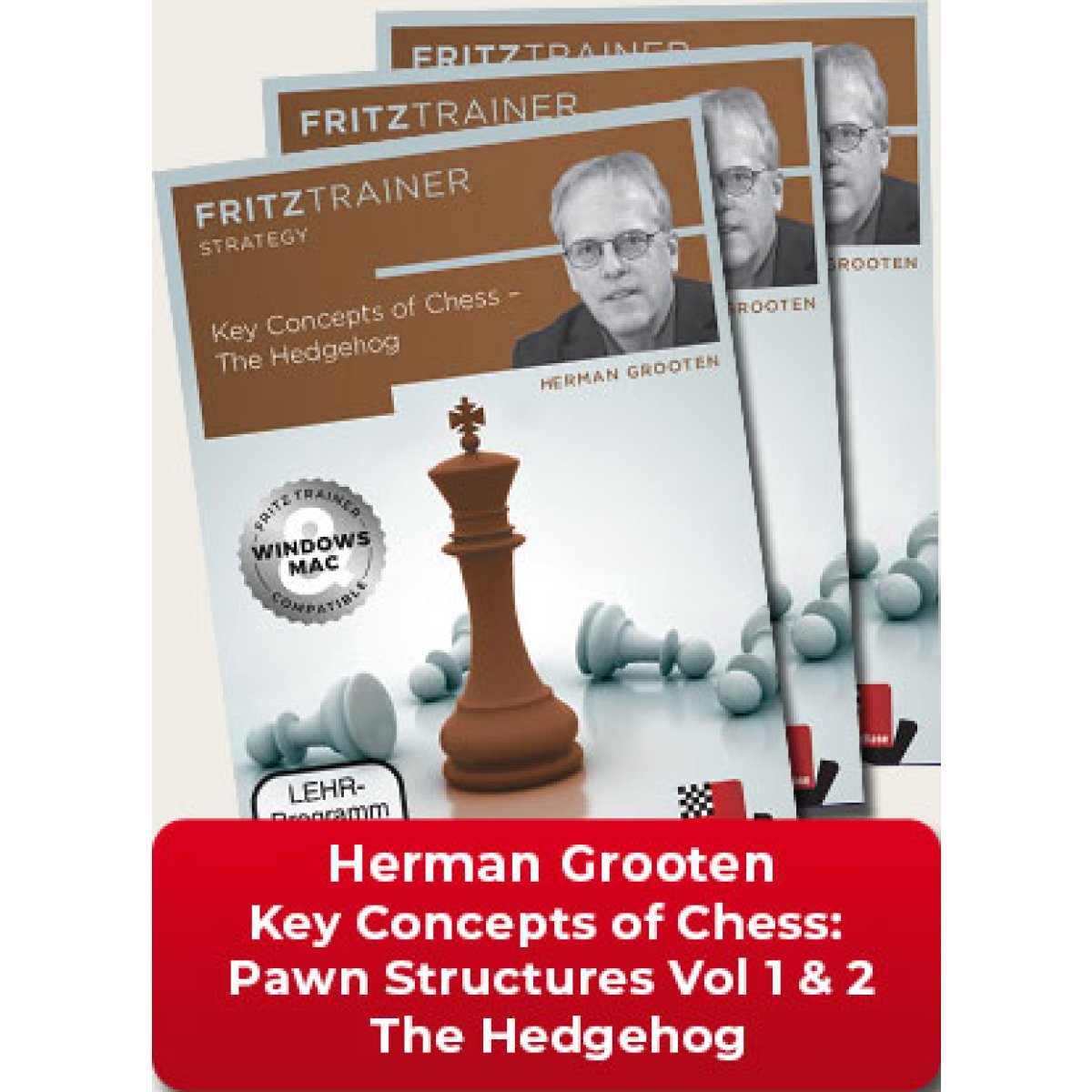

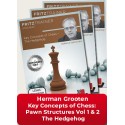
Key Concepts of Chess - Pawn Structures Vol.1 & 2 and The Hedgehog
search
  • Key Concepts of Chess - Pawn Structures Vol.1 & 2 and The Hedgehog

Key Concepts of Chess - Pawn Structures Vol.1 & 2 and The Hedgehog

€79.90
Tax included
Discover the series "Key Concepts of Chess" with IM Herman Grooten, designed for club players who want to master strategy through pawn structures. With clear explanations, practical examples, and interactive exercises, learn to maneuver pieces effectively and take advantage of themes such as open files, isolated pawns, and the "Hedgehog" system. Includes videos, analysis, and training with ChessBase to improve your game.

FORMAT: DOWNLOAD
This product is not supplied in a physical format. You will receive an email from our store with the download link and product activation code.

Quantity
In Stock

  Security policy

(edit with the Customer Reassurance module)

  Delivery policy

(edit with the Customer Reassurance module)

  Return policy

(edit with the Customer Reassurance module)

This series focuses on strategy for club players, explained simply with clear examples. The idea is to address specific topics through concrete pawn structures. The key question is: how to maneuver the pieces to optimal positions and what aspects to consider? IM Herman Grooten offers practical rules and concepts to guide club players in finding the best solutions in their games.

Key Chess Concepts - Pawn Structures Vol.1

This series focuses on strategy for club players, explained in a straightforward way with clear examples. Specific topics are studied through pawn structures. The central question is how to place the pieces in good positions and what to keep in mind. IM Herman Grooten provides rules and concepts to guide club players in their games.

This two-part course emphasizes typical pawn structures, frequently occurring in games and recognizable to club players. Therefore, the topics of "open and half-open files" and "the pawn chain" are covered extensively.

  • Video duration: 6 hours 30 minutes (in English)
  • Interactive training with video feedback
  • Extras: model games and training with ChessBase applications - Play key pawn structures

Key Chess Concepts - Pawn Structures Vol.2

Continuation of the "Key Chess Concepts" series focused on topics through specific pawn structures. The fundamental question remains how to maneuver pieces properly and consider the necessary aspects. IM Herman Grooten offers rules and concepts to help club players find good solutions in their games.

In this second part, typical structures that frequently appear and are familiar to club players are addressed. Detailed discussion covers topics such as "isolated queen pawn (IQP)" and "passed pawn in the middlegame." The IQP is common in many openings, warranting study; and the passed pawn can be decisive, something highly valued by club players.

  • Video duration: 4 hours (in English)
  • Interactive training with video feedback
  • Extras: model games and training with ChessBase applications - Play key pawn structures against Fritz at various levels

Key Chess Concepts - The Hedgehog

To properly understand openings, it is essential to study the middlegame first, since plans in this phase relate directly to opening ideas, and almost everything depends on pawn structures. Therefore, IM Herman Grooten guides the club player to analyze common middlegame structures.

In this course Grooten explains the basic ideas for White and Black of a typical structure arising from several opening variations: the so-called "hedgehog system," characterized by at least four black pawns on the sixth rank, called the "spines" of the hedgehog. Additionally, the exchange of the black c-pawn for the white d-pawn (as in the Sicilian) gives White a spatial advantage, partly due to c2-c4. However, the viability of the hedgehog is made clear in all examples presented, as the author personally employs this system.

  • Video duration: 4 hours (in English)
  • Interactive training with video feedback
  • Extras: model games and training with ChessBase applications - Play key pawn structures against Fritz at various levels
More... Less...

The package includes:

Included content:
  • Fritztrainer application for Windows and Mac
  • Available for download or on DVD
  • Video course with an approximate duration of 4 to 8 hours
  • Repertoire database: save and integrate Fritztrainer games into your repertoire (in WebApp Opening or ChessBase)
  • Interactive exercises with video feedback; the author presents exercises and key positions for the user to input solutions, with explanations and corrections
  • Model games in ChessBase database
  • New: many Fritztrainers also available for streaming on the ChessBase video portal
FritzTrainer application features:
  • Video playback in the Fritztrainer application or in ChessBase with graphics, notation, and function bar
  • Analysis engine available at all times
  • Pause video for navigation and manual analysis in the notation
  • Input own variations, engine analysis, save within the game
  • Variation learning: view specific lines with automatic playback in ChessBase WebApp Opening, memorize and practice transformations (initial - final position)
  • Active opening training: selected positions transfer to ChessBase WebApp Fritz-online to play against Fritz and test knowledge
More options: launch FritzTrainer in ChessBase:
  • Direct access to the database with all games and analyses
  • Easily add games to the opening reference
  • Direct evaluation with game reference and playback on the analysis board
  • Save own variations and add to personal repertoire
  • Training with repetitions
  • Active LiveBook
  • Use all engines installed in ChessBase for analysis
  • Assisted analysis
  • Print notation and diagrams for study materials

Sample video

Contents

    Key Chess Concepts - Pawn Structures Vol.1

  • Introduction
  • Fundamentals Part 1
  • Definitions 1
  • Definitions 2
  • Creating doubled pawns: Spiesberger-Galdunts
  • Creating doubled pawns: Van Wely-Short
  • Eliminating doubled pawns: Constructed Position
  • Winning with tripled pawns: Lysyj-Ernst
  • Playing against a backward pawn: Estrin
  • Managing tension between two pawns: Gerlagh-Mollema
  • Tension: Hibma-Breuker
  • Tension: Fischer-Taimanov
  • Typical structures: Suba-Zadrima
  • Fundamentals Part 2
  • Capture toward the center: Babula-Rustemov
  • Capture away from the center: Carlsen-Naiditsch
  • Capture away from the center: Topalov-Van Wely
  • Capture away from the center: Gershon-Shinkevich
  • Capture away from the center: Atalik-Metin
  • Capture away from the center: Lanchava-Schuurman
  • Removing tension: Sokolov-Marcelin
  • Pawn chain, attacking the base: Moskalenko-Fedorchuk
  • Isolated queen pawn - attack plan: Roiz-Beccaris
  • Passed pawn: Van der Wiel-Haver
  • Exercises
  • Exercise 1
  • Exercise 2
  • Exercise 3
  • Exercise 4
  • Exercise 5
  • Exercise 6
  • Exercise 7
  • Exercise 8
  • Open and half-open file Part 1
  • Backward pawn: Gheorghiu-Shapiro
  • Minority attack: Van den Berg-Kramer
  • Maneuvers in front of pawns: Gashimov-Ivanchuk
  • Open file and seventh rank: Zivanic-Kovacevic
  • Opening files with king in the center 1: A.Haast-Coenen
  • Opening files with king in the center 2: Avrukh-Schripkenko
  • Which is the correct file? 1: Leniart-Kriebel
  • Which is the correct file? 2: Berg-Bareev
  • Open and half-open file Part 2
  • Removing defender 1: Suba-Spraggett
  • Removing defender 2: NN-NN
  • Removing defender 3: Anastasian-Chatalbashev
  • Entering the seventh rank 1: Kveinys-Comp
  • Entering the seventh rank 2: Leko-Mamedyarov
  • Breaking down the seventh rank: Fleming-Knopf
  • The queen enters by the correct route: Grandelius-Sokolov
  • The seventh rank 1: NN
  • The seventh rank 2: Lautier-Onischuk
  • The sixth rank: Kasparov-Gavrikov
  • Exercises
  • Description
  • Exercise 1
  • Exercise 2
  • Exercise 3
  • Exercise 4
  • Exercise 5
  • Exercise 6
  • Exercise 7
  • Exercise 8
  • The pawn chain
  • Instructive example
  • Attacking the chain with White
  • Attacking the chain with Black
  • Breaking down the structure 1: Moskalenko-Fedorchuk
  • Breaking down the structure 2: Forgacs-Tartakower
  • Breaking down the structure 3: Hess-P.Gerlagh
  • Using spatial advantage: Ostovic-Rogul
  • Standard sacrifice 1: P.Kuipers-P.Gerlagh
  • Standard sacrifice 2: Kosten-Adrian
  • Summary King's Indian Defense
  • Model game for White: Korchnoi-Van Wely
  • Model game for Black: Tratat-Ye Jiangchuan
  • Exercises
  • Exercise 1
  • Exercise 2
  • Exercise 3
  • Exercise 4
  • Exercise 5
  • Exercise 6
  • Exercise 7
  • Exercise 8

    Key Chess Concepts - Pawn Structures Vol.2

  • Introduction
  • Isolated queen pawn Part 1
  • Introduction, advantages and disadvantages
  • Sacrifice Nxf7
  • Pawn break d4-d5
  • Pin on the d-file
  • Sacrifice Nxf7 1: Khenkin-Bertran
  • Sacrifice Nxf7 2: Iturrizaga-Papin
  • Sacrifice Nxf7 3: Botvinnik-Batuyev
  • Sacrifice Nxf7 4: Janev-Ilchev
  • Sacrifice Nxf7 5: Botvinnik-Vidmar
  • Isolated queen pawn Part 2
  • Elevation and rook exchange 1: Timofeev-Svidler
  • Elevation and rook exchange 2: Buhmann-Wichmann
  • Elevation and rook exchange 3: Onischuk-Vescovi
  • Pawn break d4-d5 1: Ligterink-Donner
  • Pawn break d4-d5 2: Portisch-Bilet
  • Pawn break d4-d5 3: Sokolov-Fischer
  • Pawn break d4-d5 4: Rodshtein-Diamant
  • Transition to 'hanging pawns': Donaldson-Kudrin
  • Exploiting weaknesses 1: Bojkov-Dreev
  • Exploiting weaknesses 2: Arngrimmson-Damljanovic
  • Exercises
  • Description
  • Exercise 1
  • Exercise 2
  • Exercise 3
  • Exercise 4
  • Exercise 5
  • Exercise 6
  • Exercise 7
  • Exercise 8
  • Passed pawn Part 1
  • Creating passed pawn 1: Razuvayev-Honfi
  • Creating passed pawn 2: Nielsen-NN
  • Pawn break: Thipsay-Peng
  • Advance the pawn!: A.Haast-M.Bensdorp
  • Piece positioning relative to the passed pawn 1: Hughes-Chirila
  • Piece positioning relative to the passed pawn 2: Reinderman-Bosboom
  • Piece positioning relative to the passed pawn 3: Holt-Shetty
  • Attract or repel defender: Cano Sanchez-Carrasco
  • Interference: Morozevich-Adams
  • Pin: Mentasi
  • Block square 1: Troitzky
  • Block square 2: Wall-Schuurman
  • Double attack: Engels-Maroczy
  • Passed pawn Part 2
  • Exploiting passed pawn: Halkias-Asrian
  • Creating second passed pawn 1
  • Creating second passed pawn 2: Nunn
  • Creating second passed pawn 3: Schuurman-Gara
  • Defending passed pawn 1: Zenyuk-Abrahamyan
  • Defending passed pawn 2: Van den Ende
  • Defending passed pawn 3: Zheltukhov
  • Defending passed pawn 4: Kasparov-Timman
  • Exploiting weaknesses and using passed pawn 1: Grooten-Douven
  • Exploiting weaknesses and using passed pawn 2: Petrosian-Korchnoi
  • Exercises
  • Description
  • Exercise 1
  • Exercise 2
  • Exercise 3
  • Exercise 4
  • Exercise 5
  • Exercise 6
  • Exercise 7
  • Exercise 8

    Key Chess Concepts - The Hedgehog

  • Introduction
  • Schematic plan a
  • Schematic plan b
  • Schematic plan c
  • Previous knowledge
  • Stean-Andersson
  • Learning from Hedgehog classics
  • Fischer-Andersson
  • Byrne-Andersson
  • Typical plans for White
  • Clearing the spines: the Nd5!? idea
  • Clearing the spines: a2-a4-a5
  • Clearing the spines: b2-b4 and c4-c5
  • Clearing the spines: e4-e5
  • Provoking weaknesses: f4-f5
  • Advancing g and h pawns: g2-g4-g5; h2-h4-h5; g6
  • Summary of plans for White
  • Typical plans for Black
  • Pawn advances: b6-b5
  • Pawn advances: d6-d5
  • Combined advances: b5 and ...d5
  • Bayonet pawn advance h
  • Bishop repositioning
  • Fischer's ...g5 plan I
  • Fischer's ...g5 plan II
  • The Marozcy Bind structure in relation to the Hedgehog
  • Move order with e4
  • Move order with c4
  • Move order with d4
  • Move order with Nf3
  • Personal Hedgehog games
  • Wintzer-Grooten
  • Hausrath-Grooten
  • I.Böhm-Grooten
  • Conclusion
  • Exercises
  • Exercise 01
  • Exercise 02
  • Exercise 03
  • Exercise 04
  • Exercise 05
  • Exercise 06
  • Exercise 07
  • Exercise 08
  • Exercise 09
  • Exercise 10
  • Exercise 11
  • Exercise 12
  • Exercise 13
  • Exercise 14
  • Exercise 15
  • Exercise 16
  • Exercise 17
  • Exercise 18
  • Exercise 19
  • Exercise 20
KCOC-PSV&2ATH-PWLU