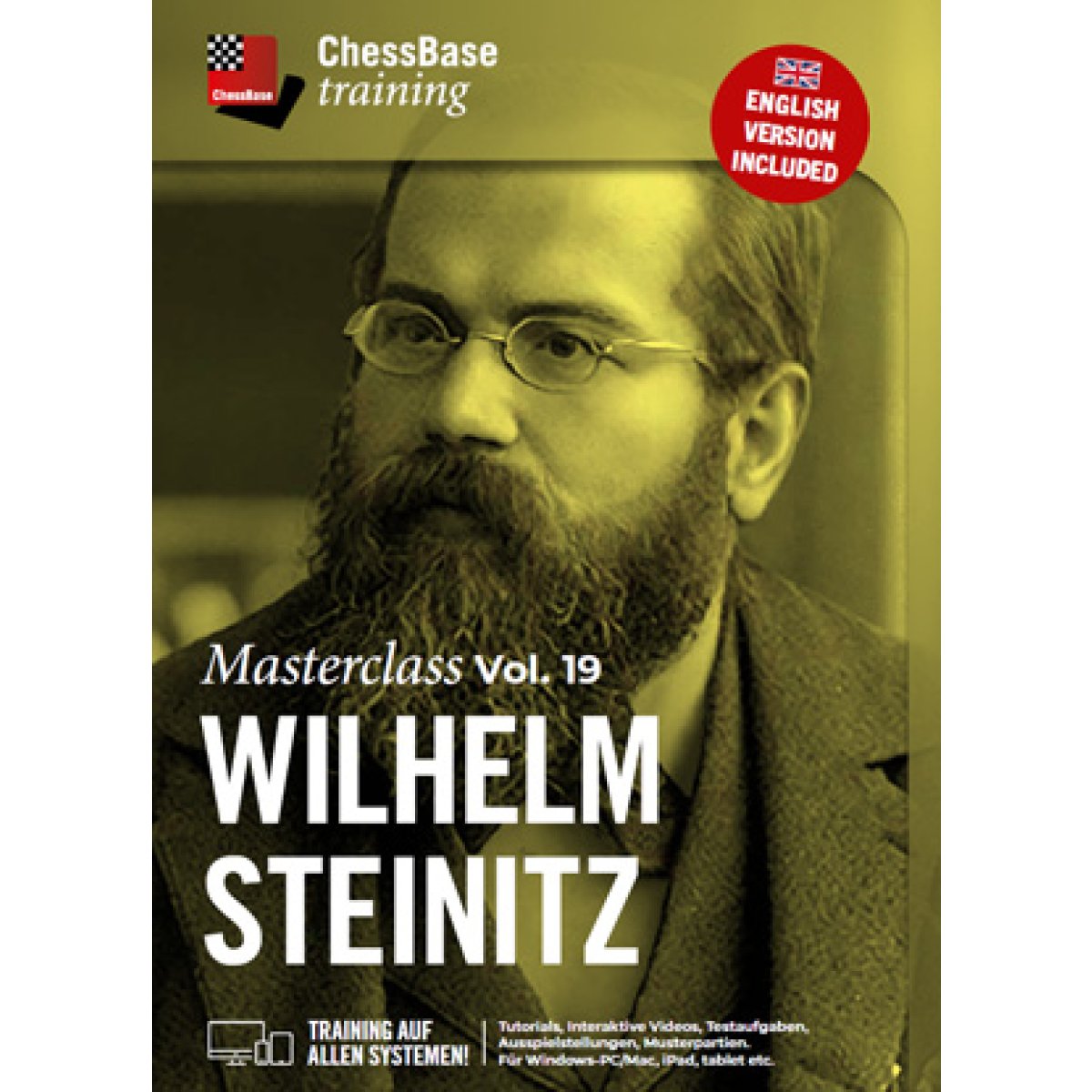


Master Class Vol. 19: Wilhelm Steinitz
search
  • Master Class Vol. 19: Wilhelm Steinitz

Master Class Vol. 19: Wilhelm Steinitz

€34.90
Tax included
Discover the legacy of William Steinitz, the first world chess champion, with this comprehensive video course. Explore his revolutionary strategies, classic openings, and tactical skills through expert analysis and interactive exercises. Available on multiple platforms, it includes databases, video feedback, and tools to integrate the knowledge into your repertoire. Ideal for players who want to master modern chess from its roots.

FORMAT: DOWNLOAD
This product is not supplied in physical format. You will receive an email from our store with the download link and product activation code.

Quantity
In Stock

  Security policy

(edit with the Customer Reassurance module)

  Delivery policy

(edit with the Customer Reassurance module)

  Return policy

(edit with the Customer Reassurance module)

William Steinitz, first World Chess Champion (1886-1894). The match between William Steinitz and Johannes Zukertort in 1886 was the first official World Chess Championship. Steinitz won and has since been recognized as the first official world champion in the history of chess.

Free sample video: The Steinitzian method of restriction

Free sample video: Strategy Introduction

In 1894, he lost the title in a match against Emanuel Lasker. William Steinitz, born in 1836 in the Prague ghetto, then Austria, moved to Vienna in 1858, where he quickly became one of the city's best players. In 1862, he moved to London, a chess hub, and stood out by defeating the world's top players in various competitions.

Steinitz is considered the founder of modern chess theory. He analyzed masters' games, formulated rules, and laid the foundations of the modern strategic-positional school, which replaced the "romantic" style characterized by bold king attacks. Besides being a prolific player, he was a distinguished writer, maintaining a chess column in "The Field" in London.

After moving to the United States, he published the magazines "The International Chess Magazine" and "The Modern Chess Instructor". In opening theory, there are variations of the Spanish Game, Scotch Game, and French Defense named after him.

In this video course, experts like Dorian Rogozenco, Mihail Marin, Karsten Müller, and Oliver Reeh analyze Steinitz's games, showing the openings he chose, his strengths in the middlegame, and how he outplayed his opponents in the endgame. Additionally, his tactical skill is highlighted in the corresponding section.

More... Less...
Included content:
  • FritzTrainer for 4 platforms: application for Windows, Mac, ChessBase books, and ChessBase Videostream
  • Delivery via download or postal shipment (card with serial number)
  • Video course with an approximate duration of 4 to 8 hours
  • Repertoire database: save and integrate FritzTrainer games into your own repertoire (in WebApp Opening or ChessBase)
  • Interactive exercises with video feedback: authors present exercises and key positions, users must enter the solution. Includes video feedback and detailed explanations
  • All videos, additional tasks, tests, and texts included in the CB books
  • Sample games in a ChessBase database
FritzTrainer application features:
  • Videos can be played in the FritzTrainer app or in the ChessBase program with board graphics, notation, and function bar
  • Analysis engine available at any time
  • Pause video for manual navigation and analysis in the game notation
  • Input of own variations and engine analysis, saved within the game
  • Variation learning: visualization of specific lines in ChessBase WebApp Opening with automatic playback, memorization, and transformation practice (starting position - final position)
  • Active opening training: selected positions are transferred to ChessBase WebApp Fritz-online to practice matches against Fritz
More options: launch FritzTrainer in the ChessBase program
  • Direct access to the database with all games and analyses
  • Easy incorporation of games into the opening repertoire
  • Direct evaluation with references to games, playback on the analysis board
  • Saving own variations and integration into the personal repertoire
  • Reproduction training
  • Active live book
  • Use of any engine installed in ChessBase for analysis
  • Assisted analysis
  • Printing notation and diagrams for worksheets
New ChessBase product installer:
  • The CB brochure contains all necessary information to install the product on your computer
  • Does not include a DVD but is a valuable addition to your collection
  • Includes detailed installation instructions and a serial number to unlock the product
  • No DVD drive required for installation
  • The brochure contributes to environmental protection, produced without plastic

Sample Video

Content

  • Introduction
  • Brief biography
  • Openings
  • Introduction
  • French Defense
  • Spanish
  • Scotch Game
  • Vienna Game
  • Strategy
  • Introduction
  • A bridge between Steinitz and modern chess
  • Game 1: De Vere - Steinitz
  • Game 2: Bricard - Marin
  • Game 3: Zuckertort - Steinitz
  • Game 4: Steinitz - Chigorin
  • Game 5: Chigorin - Steinitz
  • Game 6: Steinitz - Zuckertort
  • Game 7: Steinitz - Lasker
  • Tactics 1
  • Pihal - Steinitz 1959
  • Hamppe - Steinitz 1860
  • Steinitz - Meitner 1860
  • Reiner - Steinitz 1860
  • Steinitz - Robey 1862
  • Steinitz - NN 1862
  • Novotny - Steinitz 1862
  • Steinitz - Andersen 1862
  • Steinitz - Thorold 1864
  • Green - Steinitz 1864
  • Steinitz - Duffy 1865
  • Steinitz - Burden 1865
  • Steinitz - MacDonnell 1866
  • Tactics 2
  • Steinitz - Stern 1870
  • Fisher - Steinitz 1872
  • Steinitz - Zuckertort 1872
  • Steinitz - Anderssen 1873
  • Steinitz - Gelbfuhs 1873
  • Winawer - Steinitz 1883
  • Steinitz - Gunsberg 1890
  • Steinitz - Chigorin 1892
  • Steinitz - Pillsbury 1892
  • Waldtbrodt - Steinitz 1895
  • Steinitz - Von Bardeleben 1895
  • Tactics database
  • Additional exercises
  • Endgames
  • The Steinitzian method of restriction
  • Two bishops versus two knights
  • Opposite-colored bishops favor the attacker
  • Good knight, bad bishop
  • Attack advances in the opening
  • The transformation of advantages
  • Interactive exercise: A knight's nightmare
  • Extra endgames
  • Bonus
  • All Steinitz games
  • Steinitz book with White
  • Steinitz book with Black
  • More tactics
More...
Less...
MCV1WS-OQGJ