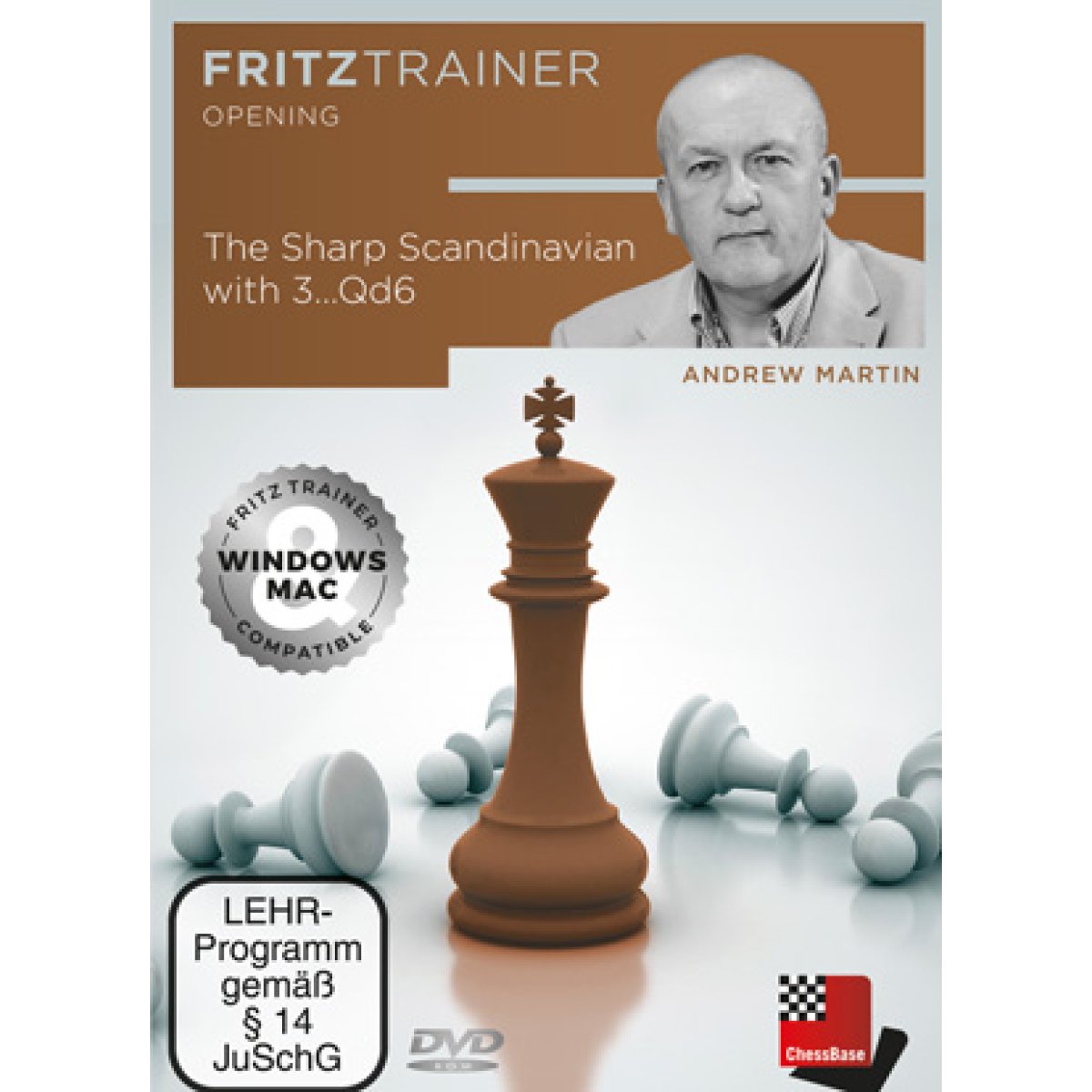

The Sharp Scandinavian with 3...Qd6
search
  • The Sharp Scandinavian with 3...Qd6

The Sharp Scandinavian with 3...Qd6

€32.90
Tax included
Discover the modern Scandinavian Defense with 3...Qd6, a practical and dynamic opening for club players. This interactive 5-hour course combines explanatory videos, exercises with feedback, and practice against Fritz to understand key ideas without memorizing long variations. Learn to master sharp lines and improve your repertoire with advanced tools in the FritzTrainer App for Windows and Mac. Ideal for deepening your knowledge of a solid and exciting opening.

FORMAT: DOWNLOAD
This product is not supplied in physical format. You will receive an email from our store with the download link and product activation code.

Quantity
In Stock

  Security policy

(edit with the Customer Reassurance module)

  Delivery policy

(edit with the Customer Reassurance module)

  Return policy

(edit with the Customer Reassurance module)

“Easy to learn and simple to play.” These are the fundamental principles on which the Modern Scandinavian is based, a defense that club players have trusted and benefited from for decades. Which variation should Black choose after 1.e4 d5 2.exd5 Qxd5 3.Nc3? Here we focus on the aggressive 3...Qd6, in contrast to 3...Qa5 or 3...Qd8. All main replies, except 3.Nc3, are illustrated with exemplary games, offering club players a clear and practical insight that will last without requiring endless hours of study. Instead of memorizing every move, the author presents model games that explain the plans and ideas offered by the Scandinavian with 3...Qd6.

The Scandinavian Defense is a practical opening that you can take advantage of. Two useful tools will help you incorporate this exciting opening into your repertoire. Practice the variations with the ChessBase Opening Trainer, reviewing the moves, guessing how the position was reached, or replaying the games at your preferred speed to deepen your understanding of the ideas behind this opening. Additionally, you can play positions against Fritz to better grasp the concepts the author presents in his videos.

  • Video duration: 5 hours
  • Interactive training with video feedback
  • Extras: Training with ChessBase applications – Memorize the repertoire and play key positions against Fritz at various levels
More... Less...
Product content:
  • Fritztrainer application for Windows and Mac
  • Available for download or on DVD
  • Video course with an approximate duration of 4 to 8 hours
  • Repertoire database: save and integrate Fritztrainer games into your own repertoire (in WebApp Opening or ChessBase)
  • Interactive exercises with video feedback: the authors present exercises and key positions for the user to enter the solution, with corrections and explanations
  • Example games in the ChessBase database
  • New: many Fritztrainers are also available for streaming on the ChessBase video portal
FritzTrainer application features:
  • Video playback in the Fritztrainer app or ChessBase with board, notation, and control bar
  • Analysis engine activatable at any time
  • Video pause for navigation and manual analysis in the notation
  • Entry of own variations, engine analysis, and saving within the game
  • Learning variations: review specific lines in ChessBase WebApp Opening with automatic playback, memorize and practice transformations (starting position – final position)
  • Active opening training: selected positions transfer to ChessBase WebApp Fritz-online to play games against Fritz and test your knowledge
More features using FritzTrainer in ChessBase:
  • Direct access to the database with all games and analyses
  • Ability to easily add games to the opening repertoire
  • Direct evaluation with references to games that can be replayed on the analysis board
  • Saving own variations to add to the personal repertoire
  • Repetition training
  • Active LiveBook
  • All engines installed in ChessBase available for analysis
  • Assisted analysis
  • Printing notation and diagrams for worksheets

Sample video

Contents

  • Introduction
  • Scandinavian motifs
  • Long castling
  • The black queen is harassed
  • Development freedom for White
  • Main lines
  • Main lines after 3...Qd6
  • 6.g3/Bc4
  • 1.e4 d5 2.exd5 Qxd5 3.Nc3 Qd6 4.d4 Nf6 5.Nf3 a6
  • 6.g3 Bg4
  • 7.h3
  • 7.Bg2 Nc6 8.d5
  • 7.Bg2 Nc6 8.0-0
  • 7.Bg2 c6
  • 6.Bc4 b5
  • 7.Bb3 Bb7 8.Ne5 e6 9.Bf4
  • 7.Bb3 Bb7 8.0-0 e6 9.Re1 c5 10.a4 c4 11.Ba2 Qc6 12.Re5
  • 7.Bb3 Bb7 8.0-0 e6 9.Re1 c5 10.a4 c4 11.Ba2 Qc6 12.Bg5
  • Alternatives on move 6
  • 1.e4 d5 2.exd5 Qxd5 3.Nc3 Qd6 4.d4 Nf6 5.Nf3 a6
  • 6.Be2 b5 7.0-0 Nbd7 8.Bg5 Bb7 9.Bh4
  • 6.Ne5
  • 6.h3
  • 5.Nge2 b6 6.Nf4
  • 6.Bg5
  • 6.Bd3 Nbd7 7.0-0 c5 8.Be3 e6
  • 6.Be3 b5 7.Bd3 Bb7 8.0-0 Nbd7
  • 5.Bc4 delaying Nf3
  • 6.a4
  • 6.Bb3
  • Alternatives on move 4
  • 1.e4 d5 2.exd5 Qxd5 3.Nc3 Qd6
  • 4.g3
  • 4...Nf6 5.Bg2 c6 6.h3
  • 4...Nf6 5.Bg2 c6 6.Nf3
  • 4...Nf6 5.Bg2 c6 6.d4
  • 4.Be2
  • 4...Nf6 5.Nf3
  • 4.h3
  • 4...Nf6 5.Nf3
  • Alternatives on move 2
  • 1.e4 d5
  • 2.Nf3
  • 2...dxe4 3.Ng5
  • 2.d4
  • 1.e4 d5 2.d4 dxe4 3.Nc3 c6 4.f3 Nf6 5.Bc4 b5
  • 1.e4 c6 2.d4 d5 3.Nc3 dxe4 4.f3 Nf6 5.fxe4 e5
  • 1.d4 d5 2.e4 dxe4 3.Nc3 Nf6 4.Bg5
  • 2.e5
  • 2...c5
  • 2.Nc3
  • 2...dxe4 3.Nxe4 Bf5 4.Qf3 e6
  • 1.Nc3 d5 2.e4 dxe4 3.Nxe4 Bf5 4.Ng3 Bg6
  • Alternatives on move 3
  • 1.e4 d5 2.exd5 Qxd5
  • 3.d4
  • 3...e5 4.dxe5
  • 3...e5 4.Nc3
  • 3...e5 4.Nf3
  • 3.Nf3
  • 3...Bg4 4.Be2 Nc6 5.d4 0-0-0 6.c4 Qf5 7.Be3 Bxf3 8.gxf3
  • 3...Bg4 4.Be2 Nc6 5.d4 0-0-0 6.c3
  • 3...Bg4 4.Be2 Nc6 5.d4 0-0-0 6.c4 Qf5 7.Be3 Bxf3 8.Bxf3
  • 3...Bg4 4.Be2 Nc6 5.d4 0-0-0 6.c4 Qf5 7.0-0
  • Conclusion
  • Epilogue
  • Exercises
  • Introduction
  • Description
  • Exercise 1
  • Exercise 2
  • Exercise 3
  • Exercise 4
  • Exercise 5
  • Exercise 6
  • Exercise 7
  • Exercise 8
  • Exercise 9
  • Exercise 10
  • Exercise 11
  • Exercise 12
  • Exercise 13
  • Exercise 14
More...
Less...

Caro-Kann Defense

The Caro-Kann Defense is named after the English master Horatio Caro (1862–1920), who lived in Berlin, and the Austrian Marcus Kann (1820–1886). However, the move 1...c6 did not gain popularity until the 1920s, when José Raúl Capablanca and Aaron Nimzowitsch began to employ it. In 1960/61, Botvinnik chose it as a solid defense for his World Championship matches against the feared sacrifices of Mikhail Tal. World champions Tigran Petrosian and Anatoly Karpov also incorporated 1...c6 into their repertoires.

TSSW3-YNHO