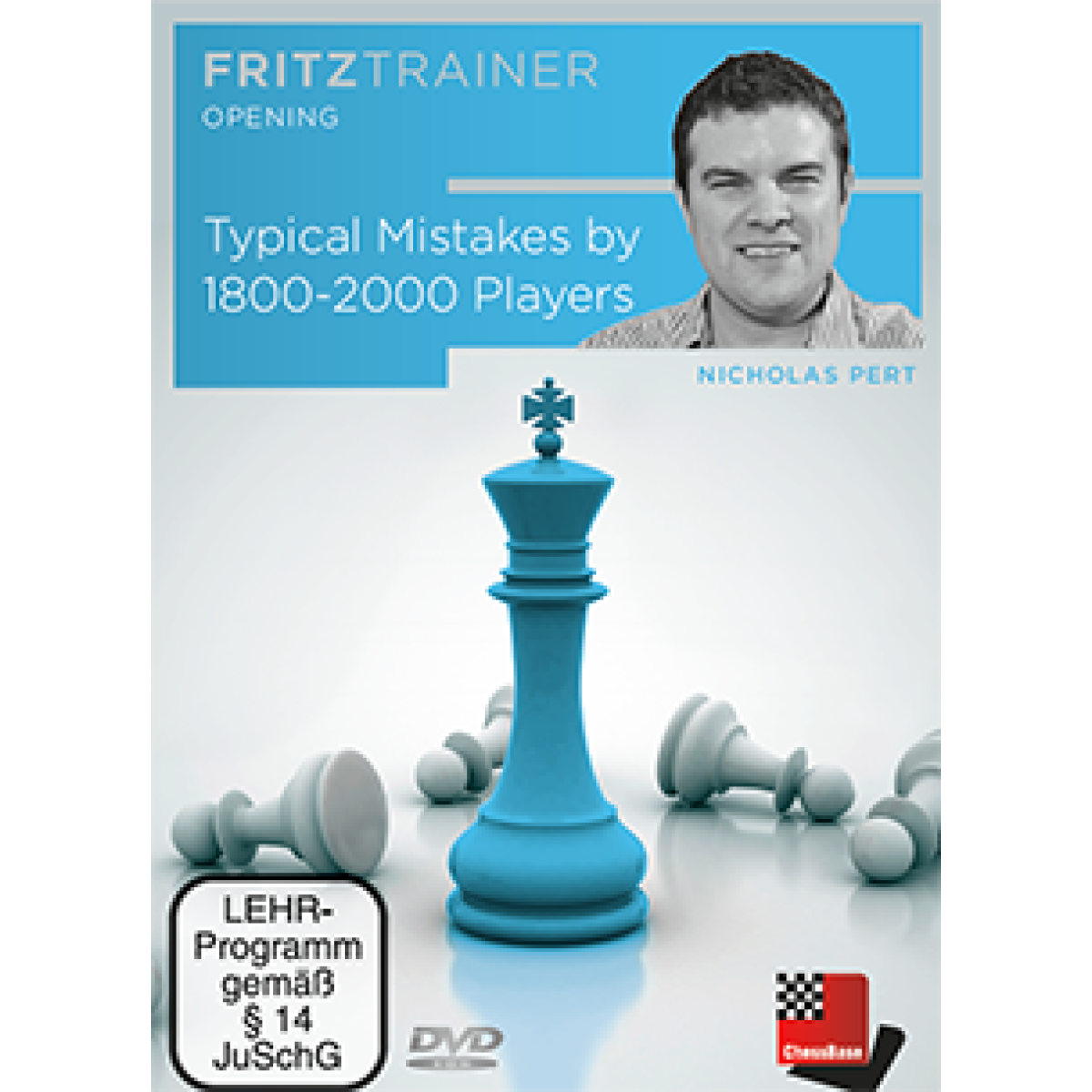

Typical mistakes by 1800-2000 players
search
  • Typical mistakes by 1800-2000 players

Typical mistakes made by players rated 1800-2000

€29.90
Tax included
This DVD by GM Nicholas Pert, aimed at players rated between 1800 and 2100, analyzes key mistakes that limit progress in chess. With nearly 4 hours of content in English, it offers practical examples and interactive exercises on topics such as exchanges, converting advantages, anticipating plans, and pawn structure. It includes 50 additional examples and advanced training tools to effectively improve your game.

FORMAT: DOWNLOAD
This product is not supplied in physical format. You will receive an email from our store with the download link and product activation code.

Quantity
In Stock

  Security policy

(edit with the Customer Reassurance module)

  Delivery policy

(edit with the Customer Reassurance module)

  Return policy

(edit with the Customer Reassurance module)

GM Nicholas Pert about his DVD: “Following the success of my previous DVD 'Typical Mistakes of Players between 1600 and 1900', I decided to create a sequel aimed at players with a slightly higher level. The examples come from games played by players rated between 1800 and 2100. This DVD presents material somewhat more complex than the previous one and offers an insight into the main mistakes which, in my opinion, prevent players in this range from achieving greater success. I have divided the content into sections such as ‘when to exchange pieces’, ‘how to convert an advantage’, ‘passive pieces’, ‘anticipating the opponent’s plan’, and ‘openings and pawn structure’. Each section includes several examples illustrating the topic, as well as practical exercises for the viewer to test their skills. This DVD is a useful training tool for ambitious players and can help identify mistakes that should be avoided.”

• Video duration: 3 hours 50 min. (in English)
• Interactive training with video feedback
• Extra content: 50 additional examples
• Includes ChessBase 12 – Reader

More... Less...
Included content:
  • Fritztrainer application for Windows
  • Available for download or on DVD
  • Video course with an approximate duration of 4 to 8 hours
  • Repertoire database: save and integrate Fritztrainer games into your own repertoire (in WebApp Opening or ChessBase)
  • Interactive exercises with video feedback: authors present exercises and key positions, the user must enter the solution. Includes detailed explanations and error correction
  • Example games in ChessBase database
FritzTrainer application features:
  • Videos can be played in the Fritztrainer application or in ChessBase, with board graphics, notation, and control bar
  • Analysis engine available at any time
  • Ability to pause the video for navigation and manual analysis in the game notation
  • Input of own variations and engine analysis, with storage in the game
  • Learn variations: view specific lines in ChessBase’s WebApp Opening with automatic playback, memorize variations, and practice transformations (starting position – final position)
  • Active opening training: selected positions are transferred to the Fritz-online WebApp to play games against Fritz and practice the learned opening
More options when starting FritzTrainer in ChessBase:
  • Direct access to the database with all games and analyses
  • Ease of adding games to the opening reference
  • Direct evaluation with reference to games, possibility to replay them on the analysis board
  • Saving own variations and ability to add them to the personal repertoire
  • Playback training
  • Active LiveBook
  • Access to all engines installed in ChessBase for analysis
  • Assisted analysis
  • Printing of notation and diagrams for working materials

Sample Video

Contents

  • 01: Introduction and Niebergall,G - Soppa,C [12:33]
  • Converting an advantage:
  • 02: Example 1 - Makka,I - Stefanidi,M [05:29]
  • 03: Example 2 - Loay,S - Holtman,T [04:01]
  • 04: Example 3 - Nastase,A - Cimpean,A [07:46]
  • 05: Test 1 - Anbukumar,H - Forster,M [04:51]
  • 06: Test 2 - Reuben,S - Lelis,J [04:04]
  • Anticipating the opponent's plans:
  • 07: Example 1 - Pert,N - Wadsworth,M [06:38]
  • 08: Example 2 - Lentzos,I - Zhu,R [05:37]
  • 09: Example 3 - Haring,V - Kolver,C [05:17]
  • 10: Example 4 - Li,W - Naiditsch,A [04:37]
  • 11: Example 5 - Remus Elliot,L - Muñoz Peláez,M [05:44]
  • 12: Test 1 - Cano Sevila,I - Cervello I Tost,R [02:53]
  • 13: Test 2 - Taalaibekov,T - Lee,J [04:31]
  • Exchanging pieces:
  • 14: Example 1 - Ranic,V - Selkovski,Z [09:54]
  • 15: Example 2 - Fox,A - Pert,N [02:59]
  • 16: Example 3 - Medic,N - Arda,C [05:50]
  • 17: Example 4 - Lyrakis,S - Kovchan,A [03:35]
  • 18: Test 1 - Kulenovic,A - Schultze,J [04:00]
  • Openings:
  • 19: Example 1 - Cheparinov,I - Stamoulas,N [03:58]
  • 20: Example 2 - Navara,D - Marentini,M [04:05]
  • 21: Test 1 - Guillemart,S - Fressinet,L [02:58]
  • 22: Test 2 - Nevednichaia,R - Samaganova,B [03:47]
  • 23: Test 3 - Ferreira,K - Moyses Sobrinho,E [03:03]
  • Not considering the opponent’s response:
  • 24: Example 1 - Golding,J - Miller,D [08:50]
  • 25: Example 2 - Twigge-Molecey,B - Perez Tores,J [09:24]
  • 26: Example 3 - Akshay V Halagannavar - Gregory,S [05:05]
  • 27: Test 1 - Fraser,J - Shafi,D [03:22]
  • 28: Test 2 - Radeva,V - Andreeva,P [02:00]
  • Passive pieces:
  • 29: Example 1 - Hrescak,I - Cai,J [03:27]
  • 30: Example 2 - Kiss,B - Koehn,L [05:07]
  • 31: Example 3 - Slade,T - Barton,A [11:29]
  • 32: Test 1 - Moore,J - Pert,N [05:43]
  • Pawn structure:
  • 33: Example 1 - Ramstad,H - Fleming,A [07:44]
  • 34: Example 2 - Kalavannan,K - González Capacete,J [05:12]
  • 35: Example 3 - Flemming,A - Khenkin,I [07:22]
  • 36: Example 4 - Vereggen,L - Ernst,S [04:30]
  • 37: Test 1 - Mihajlov,S - Vachier-Lagrave,M [07:16]
  • Miscellaneous:
  • 38: Example 1 - O'Gorman,T - Green,M [04:07]
  • 39: Example 2 - Eichner,C - Li Chao2 [01:42]
  • 40: Example 3 - Vatkali,D - Grapsa,G [03:06]
  • 41: Test 1 - Burnett,J - Willow,J [03:55]
  • 42: Test 2 - Shafi,D - Thomas,B [05:26]
  • 43: Test 3 - Ochmann,R - Hirstel,S [02:34]
  • 44: Test 4 - Pierson,E - Dereusme,J [02:08]
  • 45: Test 5 - Fraser,J - Mulligan,S [02:34]
More...
Less...

Reviews

I live in New York and have a 10-year-old son who has been playing competitive chess for several years. He currently has a rating of 1940 and is striving to surpass 2000 points. We recently acquired the new DVD “Typical Mistakes of Players between 1800 and 2000”, and it’s fantastic. My son has watched many chess videos, but this is his favorite so far; the other day he commented: “Many times I listen and think ‘what would happen if I made this move?’ and right then the video starts explaining exactly that.” Coaches have noticed that he tends to underestimate the opponent’s resources, so several segments of the DVD are proving especially useful to him.
M.H.
TMB1P-BUWD